MY SON SAID THERE WAS NO ROOM FOR ME—THEN MY LATE HUSBAND’S CARD OPENED A DOOR I NEVER KNEW EXISTED
Chapter 5 – A HOUSE WITH ROOM FOR ME
A year after Michael closed his door, I hosted Thanksgiving at my house.
That sentence would have seemed impossible the morning I found Robert’s card.
Not because I could not afford turkey.
Because twelve months earlier, I had been sleeping on a couch beneath a staircase I could not climb.
Now the house was fully accessible.
The lift hummed quietly between floors.
The front ramp blended into the landscaping instead of looking temporary.
The upstairs bathroom had a roll-in shower large enough for me to turn comfortably.
The kitchen had a section designed at wheelchair height.
Camille no longer came four mornings a week.
Two were enough now that I had adjusted.
The house was still the same house.
Robert’s desk remained in his office.
The photograph from Michael’s graduation was upright again.
That mattered.
Thanksgiving morning, Michael arrived at nine.
He knocked.
He had a key.
I had given him one again six months earlier.
Still, he knocked.
At first I thought he was being overly careful.
Then I realized it had become a ritual.
Permission.
Respect.
I opened the door with the automatic control.
“You have a key.”
“I know.”
“You can use it.”
“I know.”
“Then why knock?”
He smiled.
“Because I like being invited.”
I stared at him.
Then moved aside.
“Come in.”
Ashley arrived behind him carrying sweet potatoes.
Sophie carried rolls.
Ethan carried nothing because apparently being fourteen made him morally opposed to carrying food.
“I offered,” he said.
“No, you didn’t,” Sophie replied.
“Emotionally, I offered.”
Michael laughed.
The house filled with noise.
The exact kind I had once watched through their front window from a wheelchair outside.
Shoes near the door.
Football on television.
Ashley asking where serving spoons were.
Sophie trying to decorate my chair with removable snowflake stickers despite Thanksgiving not being Christmas.
At one point, I rolled into the kitchen and simply stopped.
Ashley noticed.
“You okay?”
“Yes.”
“You look like you’re about to cry.”
“I’m old. We cry at appliances.”
She laughed.
Then her face softened.
“I’m glad we’re here.”
“Me too.”
That was enough.
No grand declaration.
Michael had repaid thirty-six hundred dollars of the old house money.
At three hundred a month, with pauses for the air conditioner and Sophie’s dental work.
Every transfer still carried a ridiculous note.
HOUSE LOAN — STILL GOING
HOUSE LOAN — DAD WOULD HAVE MADE A SPREADSHEET
HOUSE LOAN — PLEASE DON’T CHARGE INTEREST
I saved every one.
One day he would finish.
Or maybe I would forgive the remaining balance before then.
I had not decided.
That was the important part.
I could decide later.
Robert’s trust continued growing and shrinking with markets and distributions.
I stopped checking the balance every week.
At first, the number felt like security.
Eventually, security began feeling like other things.
The lift.
The van.
Camille.
A dentist bill I paid without panic.
A weekend at the beach in an accessible hotel with June.
A new mattress.
Choice.
Money is most useful when it stops being a number and becomes room to breathe.
After Thanksgiving dinner, Ethan asked:
“Grandma, are you rich?”
Every adult at the table froze.
I nearly choked on water.
Michael closed his eyes.
Ashley said:
“Ethan.”
“What?”
“That’s rude.”
“I’m asking.”
Sophie rolled her eyes.
“You can’t just ask people if they’re rich.”
“Why not?”
“Because normal people don’t.”
I laughed.
“It’s all right.”
Ethan looked at me.
“Well?”
“I have enough.”
“That means yes.”
“No.”
“What does it mean?”
I thought about it.
“It means I can take care of myself.”
He considered that.
“That sounds rich.”
Michael looked at me.
Something passed between us.
I smiled.
“Maybe it is.”
Later, after the children went to the living room, Michael helped me load the dishwasher.
He did not need to.
I had an accessible drawer dishwasher installed during the renovation.
But he stayed.
“Ethan has no filter.”
“He’s fourteen.”
“Still.”
“I liked the question.”
Michael handed me a plate.
“Are you?”
“Am I what?”
“Rich.”
I smiled.
“Still curious?”
He laughed.
“A little.”
“Enough.”
“That answer drives me crazy.”
“I know.”
He placed another plate inside.
Then:
“I used to think Dad’s money changed everything.”
“It changed a lot.”
“I mean us.”
I looked at him.
“Did it?”
“At first.”
He nodded.
“I think when you said he left you something, my brain immediately went to what it meant for everyone.”
“Everyone meaning you.”
“Yes.”
Honesty had become easier for him.
Not painless.
Easier.
“I’m ashamed of that.”
“You don’t need to keep being ashamed forever.”
“I know.”
He closed the dishwasher.
“I think I wanted the money to explain why turning you away wasn’t so bad.”
I stared.
“What do you mean?”
“If you were suddenly financially okay, then maybe what I did didn’t matter as much.”
My throat tightened.
“That is not how it works.”
“I know.”
“You did not know about the money.”
“I know.”
“I had $237.”
“I know.”
“You sent me away thinking I had $237.”
His eyes filled.
“Yes.”
That sentence remained.
We had not needed to say it in months.
Maybe we needed to once more.
“I’m sorry.”
“I know.”
Then Michael said something I had not expected.
“If the bank account had never existed, what would you have done?”
I thought.
I had considered that many times.
“I don’t know.”
“Would you have called me again?”
“Probably.”
He looked ashamed.
“Would I have helped?”
“I hope so.”
He nodded.
“Me too.”
Then I said:
“But I don’t want our relationship measured by what might have happened in a different life.”
He looked at me.
“We have this one.”
“Yes.”
“That sounds like Dad.”
“Unfortunately.”
Michael laughed.
After everyone left, I sat alone in Robert’s office.
Not lonely.
Alone.
There is a difference.
The black Pinnacle card remained in the top drawer.
I took it out occasionally.
Not because I needed it anymore.
The banking relationship had been transferred to modern access.
The card was obsolete.
But I liked holding it.
Heavy.
Black.
Gold letters.
Twelve numbers.
HELEN ONLY.
For months, I thought the greatest gift Robert left me was the trust.
It was not.
The greatest gift was the sentence behind it.
Do not use this account to make yourself welcome where you should already be loved.
That sentence changed how I understood almost every relationship in my life.
I stopped paying for dinners every time friends went out.
Sometimes I let June buy lunch.
The first time, I practically fought her for the check.
She slapped my hand.
“Helen, let somebody do something for you without turning it into debt.”
I laughed so hard the waiter stared.
I stopped apologizing to Camille for needing help.
She was doing a job I paid her fairly to do.
I stopped pretending my wheelchair was temporary.
That one was harder.
For a long time, I had treated it like a waiting room.
Someday I would walk better.
Someday I would not need it.
Someday life would return.
Eventually, Dr. Levin asked:
“What if your life is happening now?”
That question irritated me for an entire week.
Then I ordered the better wheelchair.
Custom fit.
Lighter frame.
Comfortable cushion.
Blue.
I chose blue because Robert hated blue cars and I thought it would annoy him in heaven.
I began going places again.
Museum.
Book club.
Farmers market.
Ethan’s soccer games.
Sophie’s recital.
The world had not become inaccessible.
Parts of it were inaccessible.
There is a difference.
The trust allowed me to pay around many barriers.
But the change in me was not financial.
I stopped interpreting dependence as failure.
Everybody depends on something.
Money.
People.
Ramps.
Medication.
Schedules.
Love.
The question is not whether you depend.
The question is whether dependence becomes permission for someone else to erase you.
Michael and Ashley learned that too.
Slowly.
My relationship with Ashley remained different from my relationship with Michael.
It probably always would.
But she stopped performing warmth and began offering real things.
A ride when my van was being serviced.
Dinner delivered after a medical appointment.
A text before family events asking what accessibility I needed.
The first time she asked that question, I stared at my phone for almost a minute.
What accessibility do you need?
Not:
Can you manage?
Not:
Would it be easier if you stayed home?
What do you need so you can come?
I replied:
Ground-floor bathroom and somewhere I can park close. That’s it.
She wrote:
Done.
Two weeks later, we attended Sophie’s school concert together.
The accessible seats were already reserved.
Nobody made a speech about it.
That was progress.
At Christmas, Michael gave me a framed photograph.
It was taken on Thanksgiving.
All five of us.
I was in the center.
My blue wheelchair visible.
Not hidden behind anyone.
On the back, Michael had written:
There is always room for you.
I cried.
Then I became angry.
Then I cried again.
Michael panicked.
“I thought you’d like it.”
“I do.”
“Then why do you look mad?”
“Because you made me feel something.”
He laughed.
“Sorry.”
“Don’t be.”
I put the photograph in Robert’s office beside the college-graduation picture.
Two Michaels.
Young Michael in a graduation gown.
Older Michael behind my wheelchair.
Neither entirely good.
Neither entirely bad.
Just my son.
A human being who had failed me terribly once and then done the harder work of not demanding that one failure define every day afterward.
I had failed him too in quieter ways.
I had hidden my decline until it became a crisis.
I had trained him to think I would always solve money problems without discussing them.
I had used “I’m fine” so often that he believed it more than he should have.
Those things did not excuse the closed door.
Accountability is not arithmetic.
His wrong did not disappear because I had imperfections too.
But healing became easier when neither of us required the other person to be the only guilty one.
On the anniversary of the day I found the card, I returned to Pinnacle.
Not because I needed banking help.
I brought Marcus a small box of chocolates.
He stared at it.
“What is this?”
“An apology.”
“For what?”
“Knocking over your chair.”
He laughed.
“I did that.”
“I caused it.”
“You absolutely did.”
He came around the desk.
“How are you?”
“Good.”
“House?”
“Accessible.”
“Transportation?”
“Handled.”
“Family?”
I hesitated.
“Also handled.”
He smiled.
“I’m glad.”
I took the black card out of my purse.
“Do you remember this?”
“I will remember that thing until retirement.”
“I thought about throwing it away.”
“Don’t.”
“Why?”
“It’s a good story.”
I turned it over.
HELEN ONLY.
“Yes.”
“It is.”
Marcus looked at the words.
“Your husband sounds like he knew what he was doing.”
“Robert would be thrilled to hear a banker say that.”
We laughed.
On the drive home, I asked Rosa to take a small detour.
Michael lived only fifteen minutes away.
I had not been to his house alone since that Sunday.
I did not plan to stop.
I only wanted to see the street.
The cul-de-sac looked exactly the same.
Perfect lawns.
Matching mailboxes.
Sprinklers.
The house looked smaller than I remembered.
That surprised me.
Fear enlarges places.
So does rejection.
The front door was blue now.
Ashley had painted it.
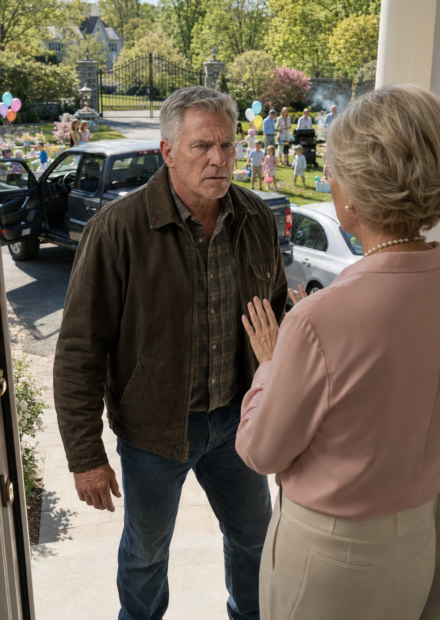
I remembered sitting outside with a suitcase.
Pharmacy bag.
$237.
I remembered Michael’s face.
His careful voice.
We have a routine.
I expected anger.
Instead I felt sadness.
Then something softer.
Distance.
Rosa looked in the mirror.
“That where your son lives?”
“Yes.”
“You want to stop?”
I considered it.
“No.”
Then I changed my mind.
“Yes.”
Rosa pulled over.
I took out my phone.
Called Michael.
He answered immediately.
“Mom?”
“Are you home?”
“Yeah.”
“I’m outside.”
Silence.
Then:
“What?”
“I was nearby.”
The front door opened before I finished.
Michael walked down the driveway.
He did not wait for me to reach the porch.
He came to the van.
Rosa opened the side door.
Michael leaned in.
“Everything okay?”
“Yes.”
He looked confused.
“Then what are you doing here?”
I smiled.
The same question he had asked a year earlier.
This time it sounded different.
“I was passing by.”
He laughed.
“Do you want to come in?”
I looked toward the house.
Ashley appeared at the doorway.
Sophie behind her.
Ethan shouting something from inside.
Warm light.
Ordinary noise.
For a second, the old wound opened.
Then closed differently.
“Yes.”
Michael grinned.
“Good.”
He moved aside while Rosa lowered the ramp.
I rolled toward the house.
Michael had installed a small threshold ramp at the entrance months earlier.
I had not known.
“What’s that?”
He looked embarrassed.
“The step was stupid.”
“Michael.”
“What?”
“You put in a ramp.”
“It’s barely a ramp.”
“It counts.”
Ashley came outside.
“We were going to tell you.”
“When?”
“After Michael finished making it look less ugly.”
“It looks fine.”
“It looks terrible,” Michael said.
Sophie ran past him.
“Grandma!”
She hugged me.
Ethan appeared.
“Are you staying for dinner?”
I looked at Michael.
He looked at Ashley.
Ashley smiled.
“Please.”
One year earlier, I had begged for a week.
Now nobody was afraid to offer one meal.
It seemed small.
It was not.
“I can stay for dinner.”
Sophie took one handle of my chair.
“I’ll push.”
“No.”
“Why?”
“Because I can move myself.”
“Oh.”
She let go.
“Sorry.”
“Thank you.”
I rolled across the threshold under my own power.
That mattered too.
Dinner was spaghetti.
Garlic bread.
Bagged salad.
Nothing special.
Michael apologized twice because he would have cooked something better if he had known I was coming.
I told him spaghetti was fine.
The children argued.
Ashley spilled water.
Ethan complained about homework.
At one point Michael asked me whether I wanted another piece of garlic bread.
I said yes.
That was all.
No bank account.
No Robert.
No apology.
No dramatic reconciliation.
Just dinner.
When I left, Michael walked beside me to the van.
“Come anytime.”
I stopped.
“No.”
He looked surprised.
I smiled.
“I’ll call first.”
He laughed.
“Fair.”
Then he kissed my forehead.
“Love you, Mom.”
“I love you too.”
On the ride home, I thought about doors.
The one Michael closed.
The bank door I entered the next morning.
The elevator door in my renovated house.
The front door I now controlled from my wheelchair.
I once believed being loved meant someone would always open every door for you.
That is not true.
People fail.
People panic.
People become selfish.
Sometimes people you love close doors when you need them most.
The harder lesson is what happens afterward.
Do you spend the rest of your life begging outside?
Do you offer money?
Forgiveness?
Pieces of yourself?
Anything that might make them reopen it?
Or do you find another entrance?
Robert left me nearly two million dollars.
That changed my practical future.
I will never pretend otherwise.
Money paid for the lift.
The accessible van.
The care.
The renovations.
The freedom to choose instead of accept whatever place someone offered me.
But Robert’s real gift was not money.
It was the warning written in his own hand.
I had spent my life giving.
To my husband.
My son.
My grandchildren.
Friends.
Church.
Neighbors.
I believed giving proved usefulness, and usefulness proved belonging.
Then I arrived at my son’s house with almost nothing left to give.
And the door closed.
That broke something in me.
The next morning, a black card taught me what needed to replace it.
Not bitterness.
Not revenge.
Self-respect.
I did not punish Michael with Robert’s money.
I did not buy a mansion and invite everyone except him.
I did not wave account statements in Ashley’s face.
I did not rewrite my will in a rage.
I used the money for exactly what Robert intended.
My life.
That decision changed the family more than revenge ever could.
Michael had to return because he wanted a mother.
Not because I was financing something.
Ashley had to apologize without receiving a reward.
I had to forgive without buying closeness.
The grandchildren learned that Grandma’s wheelchair was not a tragedy.
Just part of how Grandma moved.
And I learned that independence does not mean never needing help.
It means keeping the right to decide where that help comes from and what it costs you.
Robert has been gone six years now.
I still miss him most in the mornings.
Sometimes I roll into his office before breakfast.
Sunlight lands across the desk.
The black Pinnacle card sits inside a small wooden frame beside his photograph.
On the back, hidden from view, are those two words.
HELEN ONLY.
I used to think they sounded lonely.
Now they do not.
Sometimes “only” is not exclusion.
Sometimes it is protection.
A small space reserved for the person who has spent a lifetime giving every other space away.
My house has room for Michael.
For Ashley.
For Ethan.
For Sophie.
For friends.
For caregivers.
For laughter.
For arguments.
For grief.
But it has room for me first.
That is the part I had forgotten.
And no matter how much money sits in a bank account, that is the kind of wealth nobody can hand you.
You have to claim it yourself.