Chapter 1 – THE DRESS THEY THOUGHT DIDN’T BELONG
The worst part was not the laughter.
It was knowing my son heard every word.
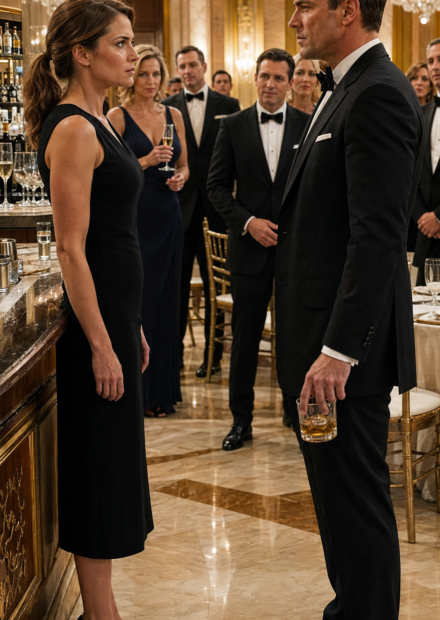
Julian stood less than ten steps away from me in a brand-new tuxedo that probably cost more than the first car his father and I ever owned, surrounded by men wearing polished shoes and watches that caught the ballroom lights every time they lifted their glasses.
He heard his bride insult me.
I know because our eyes met.
And then he looked away.
My name is Evelyn Whitmore.
I was sixty-seven years old when my only son got married at the Bellweather Grand Hotel, and until that evening, I had believed there were certain humiliations a mother could never feel in front of the child she had raised.
I was wrong.
The ballroom was not yet full when it happened.
The wedding ceremony had ended less than twenty minutes earlier, and guests were drifting toward cocktail tables while the hotel staff quietly transformed the space for dinner.
Crystal chandeliers reflected against tall mirrored walls.
White roses climbed around gold stands.
Every table had candles floating in clear glass cylinders.
A string quartet played near the far windows overlooking the city.
Nothing in that room was accidental.
Julian’s new wife, Vivian, had spent fourteen months making sure of that.
She had chosen the flowers herself.
Chosen the chairs.
Chosen the shade of ivory for the tablecloths.
Chosen which champagne would be poured during the toast.
Chosen the width of the gold ribbon around the menus.
Even the small boxes of chocolate at each place setting had been approved after three samples arrived at her apartment.
Vivian believed details told people who you were.
That was one of the first things I learned about her.
She also believed people told you who they were by the details they chose.
That was where we had always differed.
I had worn a navy silk dress.
Long sleeves.
A simple neckline.
A hem just below my knees.
No sequins.
No visible label.
No current-season cut.
It had been altered twice over the years because age changes a woman in places designers rarely admit.
I had paired it with pearl earrings Arthur gave me on our twenty-fifth anniversary and low black shoes because I had no intention of spending my son’s wedding pretending my feet were twenty years younger than the rest of me.
The dress was old.
There was no denying that.
Arthur had bought it for me nearly twenty-eight years earlier during a trip to Savannah.
We had gone because he was negotiating a supply contract and I had tagged along because Julian was spending the weekend with my sister.
Back then, the company Arthur and I had built was still young enough that every new contract felt like the difference between breathing and drowning.
We stayed in a modest room over a courtyard.
Arthur worked most of Friday.
On Saturday afternoon, he saw the navy dress in a shop window.
“Try it on,” he said.
“We are not buying that.”
“Why?”
“Because we came here to make money.”
“We came here because I have a meeting.”
“Same thing.”
He grinned.
“Try it on.”
I remember stepping out of the fitting room feeling ridiculous.
It was the nicest dress I had owned at the time.
Arthur looked at me for a long moment and said, “That color makes you look like every smart decision I ever made.”
I laughed.
“You’re trying to sell me my own dress.”
“I’m very good at sales.”
“You’re terrible.”
“We got the hotel contract.”
“You did?”
He nodded.
I hugged him so hard the saleswoman laughed.
He bought the dress.
Years later, when our life became more comfortable, I bought newer clothes.
More expensive ones.
Some designer.
Most not.
But the navy dress stayed.
I wore it to Julian’s high-school graduation.
To our thirtieth anniversary dinner.
To Arthur’s retirement celebration, though retirement lasted only eleven months because the man became unbearable without something to manage.
And I wore it once more to Arthur’s memorial dinner after he died.
Not the funeral.
I could not bear it that day.
But six months later, when we gathered his oldest employees and friends to remember him, I put on the navy dress because I needed to feel that some part of our younger life had survived.
That was the dress Vivian looked at as if I had worn curtains to her wedding.
She approached me near the ballroom entrance with three bridesmaids following her.
She looked beautiful.
I mean that sincerely.
Her gown was elegant and fitted perfectly.
Her dark hair was pinned into a low twist.
The diamond studs at her ears had belonged to her grandmother.
Whatever happened between Vivian and me later, I never needed to rewrite her into an ugly woman to explain an ugly moment.
She smiled.
Her eyes traveled down my dress.
Then back up.
“That dress…” she said.
A pause.
“It must carry a lot of memories.”
I touched the silk.
“It does.”
One bridesmaid glanced at another.
Vivian tilted her head.
“I’m sure.”
I smiled.
“Arthur loved this color.”
For one foolish second, I thought mentioning my late husband would change the conversation.
Vivian knew how much Arthur had meant to me.
She knew Julian had adored his father.
She had seen the photographs.
She had even asked me once what kind of marriage Arthur and I had.
I told her the truth.
“Long enough to be annoyed by each other properly.”
She laughed then.
But she did not laugh now.
Instead, she reached out and touched my sleeve with two fingers.
Not affectionately.
Like someone checking the fabric on a chair.
“But there will be photographers everywhere tonight,” she said.
“Yes.”
“And video.”
“I was told.”
She glanced toward the ballroom.
“Everything has to look expensive.”
There it was.
Polite words.
Sharp message.
One bridesmaid lowered her face to hide a smile.
Another did not bother.
I looked down at the dress again.
“It was expensive enough for us when Arthur bought it.”
Vivian gave a little laugh.
“I didn’t mean the price.”
“No?”
“You know what I mean.”
Actually, I did.
The dress looked old.
And Vivian did not want anything old in the photographs unless it had been intentionally styled as vintage.
I said nothing.
She continued.
“Memories are lovely.”
Then she leaned slightly closer.
“But they don’t photograph well.”
Behind her, the bridesmaids laughed.
Quietly.
Carefully.
The kind of laughter designed to give the person using it an escape route.
If challenged, they could always say it was a joke.
Maybe even say I had misunderstood.
I looked toward Julian.
He was talking to three men near the bar.
One was Vivian’s father, Richard Cole.
The others were two of Julian’s business associates.
Julian had heard.
I knew because he stopped moving.
For just a fraction of a second, his face changed.
Then his eyes found mine.
I waited.
That was all.
I waited.
I did not need him to shout.
I did not need him to embarrass his bride.
I did not even need him to take my side in some dramatic scene ten minutes after marrying her.
All he had to do was walk over.
Say, “Mom looks beautiful.”
Or, “Vivian, enough.”
Or even change the subject firmly enough that everyone understood the joke had gone too far.
Instead, my son turned back toward the men beside him.
That hurt more than Vivian.
A stranger can reduce you to a dress.
A child you raised can reduce you to silence.
I smiled at Vivian.
“Then I suppose the photographer will have to work very hard.”
One bridesmaid coughed into her champagne.
Vivian’s smile tightened.
“Evelyn, please don’t take it personally.”
People say that after making something personal.
“I’m not.”
“I just want everything perfect tonight.”
“I know.”
“And I know you’re more sentimental than I am.”
“Yes.”
“So we’re different.”
“We are.”
She seemed relieved that I had agreed.
Then she touched my arm again.
“Good.”
She moved away.
The bridesmaids followed.
I remained beside the ballroom doors.
For several seconds, I watched Julian.
He did not look toward me again.
That was when the hotel manager approached.
His name was Mateo Alvarez.
He had managed the Bellweather Grand for nine years.
He was in his early fifties, silver beginning at his temples, the kind of man who could notice a crooked napkin from across a crowded ballroom without appearing to look.
He stopped beside me.
“Mrs. Whitmore.”
“Mateo.”
His eyes followed Vivian for half a second.
Then returned to me.
“Everything is prepared.”
I gave a small nod.
“Thank you.”
“The presentation has been loaded.”
“Good.”
“And the timing?”
“After the Coles speak.”
He hesitated.
“If that still works for you.”
“It does.”
He glanced at my face.
Mateo knew me well enough to recognize when something had happened.
But he also knew me well enough not to ask in public.
“Would you like anything before dinner?”
“A glass of water.”
“I can have—”
“I know where the water is, Mateo.”
That almost made him smile.
“Yes, ma’am.”
“Don’t call me ma’am.”
“Yes, ma’am.”
I gave him a look.
He walked away.
No one nearby paid attention.
Why would they?
To most of the people in the room, I was Julian’s widowed mother.
Quiet.
Older.
Dressed simply.
The bride had mentioned once at a dinner that I was “not really into luxury.”
That was true.
But her definition of luxury and mine were very different.
Vivian thought luxury meant being seen having something expensive.
Arthur used to say luxury meant having enough money that you did not need strangers to know.
I had always agreed with Arthur.
Julian knew that.
He had grown up in a comfortable home, but not an extravagant one.
Arthur drove the same car for eleven years.
I clipped coupons until our accountant once asked whether I understood our net worth.
I told him that was how we got one.
Julian attended good schools.
We traveled.
He had opportunities.
But we never raised him to announce what things cost.
When he was sixteen, he came home furious because a classmate told him his sneakers were “basic.”
Arthur looked at his shoes.
“They cover your feet?”
“Yes.”
“Then they’re advanced enough.”
Julian hated that answer.
At sixteen, children want to belong more than they want wisdom.
I understood that.
What I did not understand was how much of that sixteen-year-old boy remained inside the thirty-seven-year-old man standing across the ballroom.
Julian had built a successful consulting firm.
Not enormous.
Not struggling.
He was good at what he did.
Arthur and I had helped him secure the first business loan.
I cosigned part of it.
Introduced him to two potential clients.
Then stepped back.
I was proud of him because he had done the rest.
When he met Vivian, I liked her at first.
She was organized.
Ambitious.
Quick.
She worked in event branding and knew how to turn an ordinary room into something people photographed.
She also loved Julian.
I believed that.
But I noticed things.
The first Christmas she spent with us, she turned over one of my serving dishes to see the maker’s mark.
At lunch one day, she asked casually whether the pearls I wore were Mikimoto.
When I told her they came from a jeweler Arthur liked downtown, she looked disappointed.
She was never openly rude then.
Just curious in a way that always seemed to require a price tag.
Her parents were similar.
Richard Cole had made his money in commercial real estate.
Her mother, Diane, sat on museum boards and could identify handbag collections by season.
They were not bad people.
But they moved through rooms with an awareness of hierarchy that exhausted me.
Who owned what.
Who knew whom.
Who vacationed where.
Which club had a waiting list.
Which school was difficult to enter.
Which neighborhood was no longer fashionable.
They had been welcoming to Julian.
Very welcoming.
Sometimes I wondered whether part of him had spent years waiting to enter a family like theirs.
That thought hurt more after the dress conversation.
“Evelyn.”
Diane Cole appeared at my side.
She wore pale gold.
Her gown was understated in the way extremely expensive gowns are often understated.
“You look comfortable.”
There are words that become insults only through tone.
“Very.”
She smiled at my dress.
“Is that vintage?”
“In a sense.”
“How charming.”
I nearly laughed.
Diane looked across the ballroom.
“Vivian has worked so hard.”
“It shows.”
“We told her not to worry about cost.”
“That was generous.”
“She wanted the evening to reflect who they are becoming.”
I looked at her.
“Becoming?”
“As a couple.”
“Of course.”
Diane smiled.
“Julian has done very well.”
“Yes.”
“Richard thinks he’ll do even better with the right connections.”
I felt something cool move through me.
“The right connections.”
“You know how business is.”
“I do.”
She had no idea how well.
Then Diane touched my arm.
“Tonight will be good for him.”
“For his marriage?”
“For everything.”
I looked toward my son.
For the first time all evening, I wondered exactly what Julian had told Vivian’s family about ours.
Not lies necessarily.
Julian was rarely that foolish.
But omissions?
He had become skilled at those.
The company Arthur and I built had never carried Julian’s first name.
He never worked there after college.
He wanted his own career.
I respected that.
And because Whitmore Hospitality Group used a small corporate office downtown instead of a glamorous headquarters bearing our name in giant letters, plenty of people did not connect me to it.
The Bellweather Grand itself kept its original name after we acquired it eleven years earlier.
Most guests had no reason to know who sat behind the holding company.
I preferred it that way.
I had spent my life building a business.
I had no interest in becoming a brand.
Vivian’s family apparently knew almost nothing.
That had never bothered me.
Until that night.
Not because I needed them impressed.
Because suddenly I wanted to know whether Julian had allowed them to believe I was insignificant.
Dinner began.
I was seated at a family table near the stage.
Julian and Vivian sat at the center table.
Richard and Diane beside them.
I sat on Julian’s other side, with my sister Ruth and her husband.
Ruth looked at my dress and smiled.
“Arthur’s favorite.”
“Yes.”
“You trying to make me cry before soup?”
“Not intentionally.”
She narrowed her eyes.
“What happened?”
“Nothing.”
“Evelyn.”
“I’ll tell you later.”
Ruth looked across the table at Vivian.
Then at Julian.
My sister had known me for sixty-five years.
She did not need much evidence.
“Do I need to trip someone?”
“No.”
“I wore sensible shoes for nothing?”
I laughed despite myself.
That helped.
Dinner was beautiful.
The food was excellent.
It should have been.
I had approved the final menu with Mateo after Julian called me three months earlier.
Not that Vivian knew.
That part had happened because the wedding budget expanded.
At first, Richard Cole had offered to pay for much of the reception.
Julian and Vivian insisted they wanted to contribute too.
I offered privately to cover the venue.
Julian resisted.
“Mom, no.”
“It is my wedding gift.”
“You already gave us a gift.”
“I bought you cookware.”
“Very expensive cookware.”
“Then consider this the oven mitt.”
He laughed.
Eventually he accepted on one condition.
“No announcement.”
“Gladly.”
I had no interest in having my name printed on a menu.
Mateo handled the invoice quietly through my family account.
The Coles believed they were paying for several major wedding costs.
They were.
Flowers.
Music.
Photography.
A portion of catering.
But the ballroom, staffing, wine package, and most of the dinner had been mine.
Not because Julian could not afford it.
Because I wanted to give my son something joyful.
No one needed to know.
Especially not Vivian.
That had been my choice.
Now, sitting in my old navy dress while people discussed how expensive everything looked, I wondered whether my silence had done more than protect privacy.
Maybe it had allowed Julian to become comfortable with people misreading me.
After the main course, Mateo appeared near the stage.
He gave me the smallest nod.
The screen behind the band remained dark.
For now.
The speeches were beginning.
Richard Cole went first.
He spoke well.
Warmly.
He welcomed Julian into the family.
He talked about Vivian as a child.
He made everyone laugh with a story about her reorganizing her toy shelf by color at age five.
Then his tone became sentimental.
“We wanted to give these two a celebration worthy of the future they’re building.”
Applause.
Diane dabbed her eyes.
Vivian smiled.
Richard lifted his glass.
“And if tonight looks a little extravagant, blame a father who only gets one daughter.”
More laughter.
I looked at Julian.
His smile had disappeared.
Only slightly.
Enough for me to see.
Because he knew what everyone else did not.
Richard had paid generously.
But not for the room he was standing in.
Not for the staff pouring his champagne.
Not for the wine in his glass.
Not for the dinner.
Julian looked toward me.
This time he did not look away immediately.
There was something in his expression.
Worry.
Maybe shame.
Maybe both.
Then Mateo moved closer to the lighting console.
The next speaker finished.
Applause rose again.
Vivian leaned toward Julian, smiling.
The microphone was handed toward me.
I stood.
My navy dress fell into place around my knees.
Ruth squeezed my hand once.
“Be nice,” she whispered.
“I always am.”
“That is what worries me.”
I walked toward the stage.
Behind me, I heard one of the bridesmaids whisper something and laugh again.
I did not turn around.
I took the microphone.
For a moment, the room went quiet.
Then the lights softened.
The screen behind me came alive.
The first slide appeared.
White lettering against deep navy.
My name.
EVELYN WHITMORE
And beneath it, in smaller letters:
CO-FOUNDER AND CHAIR
WHITMORE HOSPITALITY GROUP
A second line appeared.
OWNER — BELLWEATHER GRAND HOTEL
No one laughed.
Not one person.
I looked at Vivian.
Her face had gone completely still.
Then I looked at my son.
Julian closed his eyes.
And in that instant, every person in the ballroom understood the same thing.
The widow in the old navy dress had never needed to look wealthy.