Chapter 2 – WHAT MY SON NEVER TOLD THEM
There are different kinds of silence.
There is peaceful silence.
Awkward silence.
Grieving silence.
Then there is the silence of a room realizing it has made a mistake.
That one has weight.
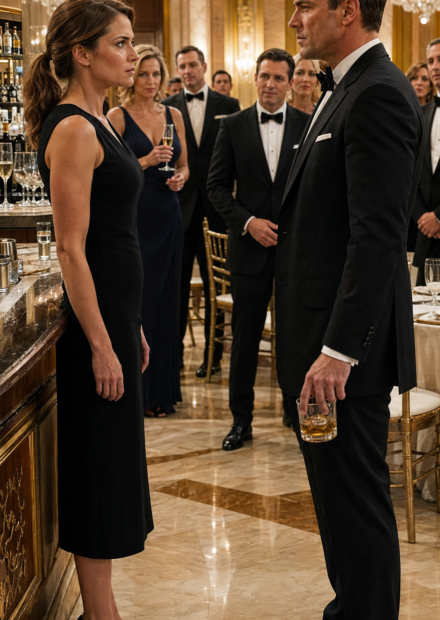
I felt it move across the ballroom.
Someone near the back coughed.
A champagne glass touched a table too hard.
One of Vivian’s bridesmaids slowly lowered her phone.
I looked at the screen.
Seeing my name that large made me uncomfortable.
It always had.
That was exactly why I rarely used my title outside business.
The slide had not been designed to expose anybody.
It had been prepared weeks earlier as part of the toast Julian had asked me to give.
He wanted me to talk briefly about Arthur and marriage.
Mateo’s staff offered to include photographs.
I agreed because the idea of Arthur appearing somehow at Julian’s wedding comforted me.
The first slide was supposed to identify me for guests who did not know who was speaking.
Nothing more.
Yet one line beneath my name had just rearranged the entire room.
Owner — Bellweather Grand Hotel.
Vivian stared at me.
Then at Julian.
Then back at the screen.
I saw the question before she asked it.
Not aloud.
Not yet.
You knew?
Of course Julian knew.
He had grown up walking through hotels under renovation.
He had done homework in temporary offices while Arthur argued with electricians.
He had spent summers folding towels badly when I decided the owner’s son needed to understand housekeeping before he spent another month complaining about chores.
He knew exactly what Whitmore Hospitality was.
He also knew I hated public displays of money.
That was why he had not warned Vivian about the slide.
Or perhaps there was another reason.
I did not know yet.
I turned toward the audience.
“My son asked me to say a few words about marriage.”
A few nervous laughs.
I smiled.
“Apparently the hotel has decided to include my résumé.”
That released the room slightly.
People laughed.
Even Richard.
Vivian did not.
I continued.
“I promise the résumé is the least interesting thing about me.”
The next slide appeared.
Arthur and me.
Young.
Standing in front of our first business.
A converted commercial laundry in a brick building with one loading door and a sign Arthur had painted himself.
WHITMORE LINEN SERVICE.
I looked at his face.
Even after nine years without him, photographs could surprise me.
Grief becomes less violent.
It does not become predictable.
“That man,” I said, “was Arthur Whitmore.”
Julian looked up.
“My husband for forty-two years.”
The next photograph showed Arthur loading stacks of sheets into a van.
His hair was dark.
His shirt had sweat stains.
I stood beside him wearing jeans and holding a clipboard.
“We did not start in hotels.”
People listened.
“We started washing sheets for them.”
Another photograph.
Our first delivery van.
A dent in the passenger-side door.
Arthur refused to repair it for two years because, in his words, the dent did not affect the engine.
I smiled at the memory.
“When Arthur and I began, we had one commercial washer we could barely afford, two borrowed delivery carts, and a van whose passenger door only opened from the inside.”
The ballroom laughed.
“We washed restaurant linens, motel sheets, tablecloths, anything people would pay us to clean.”
I looked toward Julian.
“He was seven when we started.”
The screen changed.
Julian asleep on two folded blankets in the corner of our first office.
His mouth open.
One shoe missing.
Laughter softened the room.
Julian shook his head.
“You promised never to show that.”
“I promised nothing.”
More laughter.
His face relaxed for one second.
Then tightened again when Vivian looked at him.
The next slide showed our second facility.
Then the first small inn we purchased fifteen years after beginning the linen company.
The Harbor View Inn.
Forty-two rooms.
Leaky roof.
A lobby that smelled faintly of mildew.
Arthur loved it immediately.
I thought he had suffered a head injury.
“We bought our first hotel because one of our laundry customers was going bankrupt.”
A few people laughed.
“Arthur came home and said, ‘We should buy it.’”
I shook my head.
“I asked whether he had confused providing clean sheets with knowing how to run the building containing them.”
The room laughed again.
“He had.”
Another photograph.
Arthur holding keys.
Me standing beside him looking terrified.
“But we learned.”
We did.
Slowly.
Painfully.
We hired people smarter than us.
Kept the good ones.
Listened.
Expanded carefully.
One inn became three.
Three became six.
The linen business eventually became a hospitality-services division.
We acquired the Bellweather eleven years before Julian’s wedding.
It had been beautiful but poorly managed.
Arthur saw possibility.
I saw debt.
He usually won those debates.
He also usually made them work.
The next slide showed Arthur and me in the Bellweather lobby shortly after the purchase.
The carpets were different.
The chandeliers had not yet been restored.
I wore work pants.
Arthur held a roll of blueprints.
I looked toward Mateo.
“He came six months after that photograph.”
Mateo smiled from near the wall.
“And has done most of the difficult work since.”
Applause began.
Mateo shook his head.
I raised my glass toward him.
“The smartest thing Arthur and I ever learned was that owning something does not mean you know how to run it.”
That line landed differently than I intended.
Or perhaps exactly as it should.
Vivian looked down.
Julian looked at me.
I continued.
“We built a comfortable life.”
I did not give numbers.
Never have.
“We built more than Arthur and I expected when we started.”
The next slide was not a building.
It was the navy dress.
Not the dress itself.
A photograph from Savannah.
Arthur and me outside a restaurant.
I wore the same dress I was wearing now.
I heard a small sound from the bridal table.
Vivian.
The photograph was almost three decades old.
My hair was darker.
Arthur’s hand rested at my waist.
We were both laughing at something outside the frame.
“This dress,” I said, touching the fabric at my hip, “was purchased the weekend we won our first full hotel-linen contract.”
The room went very still again.
I did not look at the bridesmaids.
I did not need to.
“Arthur insisted on buying it.”
I smiled at the photograph.
“I told him we should save the money.”
A few people laughed.
“He told me the dress was a celebration.”
I paused.
“He died nine years ago.”
The room softened.
“And every time I wear it, I remember who we were before anyone thought our name belonged on a hotel.”
I looked at Julian.
He was crying.
Not openly.
But I knew my son.
His lower lip tightened exactly the way it had when he was ten and trying not to cry in front of his father.
I continued.
“Marriage has very little to do with how things photograph.”
Vivian lifted her eyes.
I did not say the sentence cruelly.
That mattered to me.
“If you are lucky, marriage will become old.”
I touched the navy sleeve.
“It will become worn in places.”
A few older couples smiled.
“It will hold stories nobody else can see.”
I looked at Julian and Vivian together.
“And if you are very lucky, you will stop needing it to look impressive to strangers.”
No one moved.
The words were not in my prepared toast.
Those were new.
But they were true.
I lifted my glass.
“My wish for Julian and Vivian is not that everything always looks beautiful.”
I looked at my son.
“It is that when things stop looking beautiful, you still remember what they are worth.”
Julian’s face broke then.
He lowered his head.
Vivian sat motionless.
“To Julian and Vivian.”
Glasses lifted.
“To what lasts.”
The room repeated it.
“To what lasts.”
I handed the microphone back.
Applause began.
Not explosive.
Not theatrical.
Warm.
Longer than I expected.
I walked toward my table.
Before I reached it, Richard Cole stood.
“Evelyn.”
I turned.
His face was red.
Whether from champagne or embarrassment, I could not tell.
“I had no idea.”
“I know.”
His eyes flicked toward the screen.
“You own the Bellweather?”
“Through our company.”
“All of it?”
“Enough.”
That made him laugh awkwardly.
“I feel ridiculous.”
“Why?”
He looked toward his daughter.
“Because I’ve been talking all night like…”
He stopped.
“Like what?”
He shook his head.
“Never mind.”
I touched his arm.
“Richard, you paid for a beautiful wedding for your daughter.”
“Some of it.”
“Yes.”
He looked at me.
“You covered the venue.”
“Julian told you?”
“No.”
He looked toward Mateo.
“Someone explained.”
I sighed.
That irritated me.
Not because it was secret anymore.
Because I never wanted it turned into a contest.
“Richard.”
“Yes?”
“This is not a scoreboard.”
He went still.
“I didn’t stand up there to prove I spent more than you.”
“I know.”
“Do you?”
He nodded slowly.
“I think so.”
“Good.”
I walked away.
Vivian did not approach me immediately.
That surprised me.
I expected anger.
Or embarrassment disguised as anger.
Instead, she remained at the bridal table.
Julian leaned toward her.
She said something.
He answered.
Her face changed.
Then she stood and left through a side door.
Julian started to follow.
Stopped.
Looked at me.
Then followed her.
Ruth appeared beside me carrying two glasses of wine.
“One for me,” she said.
“And the other?”
“Also for me if you don’t take it.”
I took it.
She grinned.
“You were nice.”
“I told you.”
“You were terrifyingly nice.”
“I gave a wedding toast.”
“You dismantled three generations of snobbery using a photograph of a laundry van.”
I laughed.
“Ruth.”
“I’m proud of you.”
“I didn’t do anything.”
She stared at me.
“That is nonsense.”
I looked toward the door Vivian had used.
“I did not want to humiliate her.”
Ruth’s expression softened.
“I know.”
“That’s important.”
“She humiliated you.”
“I know.”
“And Julian let her.”
That one hurt again.
“Yes.”
Ruth took a sip.
“What are you going to do about him?”
“I don’t know.”
For all the dramatic silence in the ballroom, that was the question that frightened me.
Money was easy compared with family.
Businesses had contracts.
Buildings had deeds.
Invoices had numbers.
Love had no accounting system.
You could give someone everything and still discover they had been ashamed of receiving it.
Ten minutes later, Julian returned alone.
He found me near the windows.
“Mom.”
“Where is Vivian?”
“With her mother.”
“Is she all right?”
He laughed once without humor.
“No.”
I waited.
He looked at my dress.
Then at the floor.
“I’m sorry.”
“For what?”
His face tightened.
“You know.”
“No.”
I needed him to say it.
“That’s not fair.”
“Neither was tonight.”
He closed his eyes.
“You heard her.”
“Yes.”
“You heard the bridesmaids.”
“Yes.”
“And?”
“I froze.”
“Why?”
He looked toward the ballroom.
“Because it was our wedding.”
“That explains why you didn’t start a fight.”
He looked at me.
“It does not explain why you pretended not to hear.”
His eyes filled.
“I didn’t know what to do.”
I felt anger then.
Clean.
Quiet.
“You knew exactly what to do when you were eight.”
He frowned.
“What?”
“If someone laughed at another child, you told them to stop.”
“Mom.”
“When you were fourteen, you got detention for defending a boy people mocked for wearing thrift-store clothes.”
“I remember.”
“So do I.”
I stepped closer.
“What happened to that boy?”
He looked away.
“I don’t know.”
“No.”
My voice softened.
“What happened to you?”
His face changed.
Not anger.
Pain.
“I wanted tonight to go well.”
“So you sacrificed me to the atmosphere?”
He flinched.
“I didn’t think of it like that.”
“I know.”
That was almost worse.
I looked through the glass toward the city lights.
“Did Vivian know about the company?”
Silence.
There it was.
I turned back.
“Julian.”
“She knew you had investments.”
My stomach tightened.
“Investments.”
“Yes.”
“What did you tell her?”
“That Dad had done well.”
“Arthur and I built it together.”
“I know.”
“Did she?”
He hesitated.
“No.”
I stared at him.
“Why?”
He rubbed a hand over his face.
“I don’t know.”
“You do.”
He looked angry now.
“Because every time your name came up with her parents, I didn’t want the conversation to become about the family business.”
“Why?”
“Because I wanted my company to be mine.”
“It is.”
“I wanted what I accomplished to count.”
“It does.”
“You say that.”
“I mean it.”
He shook his head.
“You don’t understand what it feels like when people find out your parents have money.”
I almost laughed.
“Julian, I spent twenty years in rooms where men assumed Arthur built the company and I was his wife.”
“That’s different.”
“Is it?”
“Yes.”
“How?”
“Because you actually built it.”
“And you actually built your firm.”
He went quiet.
“Who convinced you otherwise?”
He looked toward the door Vivian had used.
That was enough.
Not that Vivian had said it directly.
I did not believe that.
But somewhere in Julian’s life with her world of appearances, he had begun fearing that the truth about his family would diminish his independence.
So he made us smaller.
Not poor.
Just unimportant enough that nobody would question how much of his success belonged to him.
I understood the fear.
Understanding did not make it painless.
“You let them think I was ordinary.”
He looked at me helplessly.
“You are ordinary.”
I stared.
His face went pale.
“No. That came out wrong.”
I almost smiled.
“Did it?”
“You know what I mean.”
“Yes.”
I did.
And strangely, it helped.
Because I was ordinary.
At least in every way that mattered.
I liked grocery-store coffee.
I reused gift bags.
I had argued with Arthur about leaving lights on.
We had money.
That had not made us different species.
I said, “Being ordinary was never the insult.”
Julian looked at me.
“Treating ordinary people as if they deserve less respect is.”
He closed his eyes.
That landed.
“Mom.”
“I need some air.”
“Can we talk?”
“Tomorrow.”
“Please.”
“Julian.”
He stopped.
“I am not leaving your wedding angry.”
His face softened.
“I am going back inside.”
I touched his cheek.
“You should find your wife.”
Then I returned to the ballroom.
I stayed.
That mattered to me.
I danced once with Julian.
I danced once with Richard because he insisted.
I ate cake.
I spoke kindly to Vivian’s relatives.
I thanked the staff.
I did not let one cruel moment steal my son’s entire wedding.
But near midnight, as guests began leaving, Vivian approached me.
Alone.
Her makeup had been repaired.
Her expression had not.
She stood in front of my navy dress and said quietly, “You made me look stupid.”
I looked at her.
“No, Vivian.”
Her eyes hardened.
“You knew exactly what that presentation would do.”
“The presentation was prepared before tonight.”
“You expect me to believe that?”
“Yes.”
“You could have warned me.”
“About what?”
Her mouth opened.
Then closed.
I waited.
“About who you are.”
That sentence told me the conversation we really needed to have had not even begun.