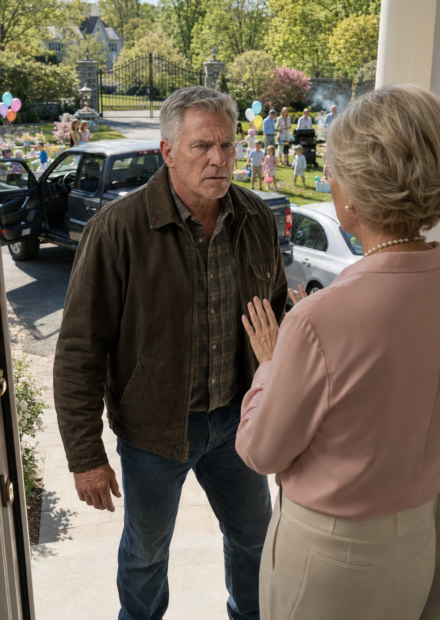
Chapter 5 – THE HOUSE I BOUGHT FOR HER
Six months after I came home from Dubai, the house looked almost exactly as it had in the photographs Mom used to send me.
That surprised me.
I expected healing to require visible transformation.
New walls.
New furniture.
Some grand redesign.
Instead, we restored.
Mom brought back the framed family pictures.
The oak console table returned to the entryway.
The blue patio chair sat beneath the covered roof.
We kept the white sectional.
That was Mom’s decision.
“It’s comfortable.”
“It cost you almost six thousand dollars.”
“It cost you.”
“Same difference.”
“No.”
She smiled.
“Apparently not anymore.”
She was right.
I had stopped thinking every dollar I gave family ceased to belong to any particular person.
That vagueness had been dangerous.
Not because generosity was bad.
Because unclear generosity becomes easy to reinterpret.
The monthly three thousand dollars continued.
But Mom managed it.
I no longer asked for every detail.
She showed me things when she wanted advice.
Not permission.
Her emergency contacts remained under her control.
Her passwords were hers.
I knew where copies were stored only because she chose to tell me.
The lifetime occupancy documents sat in a fireproof box.
Sometimes I caught her checking them.
The first few months, she looked almost embarrassed when I noticed.
Then one day I asked:
“Still there?”
She nodded.
“Good.”
That was all.
Khloe visited every other Sunday.
At first, only for an hour.
Then lunch.
Then an afternoon.
She never stayed overnight.
Not because Mom forbade it forever.
Because nobody was ready.
The first time Khloe stepped onto the back patio after everything happened, she stopped.
Her eyes went to the stone beneath the outdoor kitchen.
Mom noticed.
Neither said anything.
Then Khloe picked up a cloth.
Mom said:
“No.”
Khloe froze.
“I was just going to wipe the counter.”
“I know.”
Mom smiled.
“Sit down.”
Khloe did.
I watched from the kitchen.
That tiny moment meant more than any apology.
They were learning new roles.
Mother.
Daughter.
Not host and dependent.
Not provider and caretaker.
Not owner and servant.
Just family with edges.
Julian did not come.
For months.
His marriage to Khloe went through its own reckoning.
I never asked for details.
Some things were not mine.
I knew they were still together.
I knew Khloe had insisted they move into a rental apartment under both names.
I knew she opened her own bank account.
I knew they began counseling.
That was enough.
One afternoon, Harrison called.
“You have a letter.”
“From whom?”
“Julian.”
“Why does he send letters through you?”
“Because he has finally discovered restraint.”
I laughed.
“What does it say?”
“I do not open client mail.”
“You open everything.”
“Only when authorized.”
“Fine.”
I picked it up the next morning.
The envelope was plain.
Julian’s handwriting surprised me.
Neater than expected.
Natalie,
I have rewritten this several times.
You probably expect me to tell you that you misunderstood me.
You did not.
That first line mattered.
I kept reading.
He wrote that when he and Khloe first moved in, he had been grateful.
Then embarrassed.
He had lost a consulting contract.
Their finances were tighter than they admitted.
Living in a house owned by his wife’s successful sister made him feel small.
Instead of leaving quickly, he began compensating.
He hosted people.
Bought furniture.
Made decisions.
Called contractors without asking.
The more the house looked like his, the less dependent he felt.
Then he wrote:
Your mother made that easy because she rarely said no twice.
I hated the sentence.
Because it sounded like blame.
Then came the next one.
That does not excuse me. It makes what I did worse. I learned which boundaries would disappear if I pushed long enough.
I stopped.
Read it again.
That was the closest anyone had come to naming what happened.
He wrote about the cards.
The passwords.
The master bedroom.
The parties.
Then the word maid.
I called Martha the maid as a joke because I had become comfortable treating her work as invisible. I said she liked staying busy because that explanation allowed me not to notice how much I expected from her.
My anger returned.
Strong.
Then passed.
He ended:
I am not asking to come back into the house. I understand that I have not earned that. I am asking whether, someday, I may apologize to Martha in person if she wants to hear it.
No defense.
No legal threat.
No complaint about money.
I took the letter to Mom.
She read it twice.
Then folded it.
“What do you think?” I asked.
“I don’t know.”
“That is allowed.”
“He sounds different.”
“Maybe.”
“Do you believe him?”
“That doesn’t matter.”
She looked at me.
“Of course it matters.”
“No.”
I shook my head.
“What matters is whether you want to hear him.”
Mom looked at the letter again.
“Not yet.”
“Then not yet.”
Three months passed.
Then one morning, while we drank coffee, Mom said:
“I want to invite Julian for lunch.”
I almost dropped my cup.
“You do?”
“Yes.”
“Why?”
“To see him.”
“That is not an answer.”
“It is mine.”
I smiled.
“Fair.”
“Will you be here?”
“If you want.”
“I do.”
Khloe brought him.
Julian looked different.
Not dramatically.
Same face.
Same height.
No robe.
No scotch.
He wore jeans and a plain shirt.
He stopped at the front door.
Mom opened it.
He did not step inside.
“May I come in?”
My mother’s face changed.
I saw memory.
Pain.
Fear.
Then something steadier.
“Yes.”
He entered.
No hug.
No handshake.
Lunch was simple.
Chicken salad.
Bread.
Tea.
Nobody mentioned Dubai.
Nobody mentioned money.
Then, after plates were cleared, Julian looked at Mom.
“I owe you an apology.”
Martha said nothing.
He continued.
“I treated being allowed here as if it meant I had authority.”
Her eyes filled.
“I let the fact that Natalie owned the house make me feel insecure.”
He looked at me briefly.
Then back to Mom.
“So I acted like ownership was something I could perform.”
Mom listened.
“I took over rooms.”
“Yes,” she said.
“I took over accounts.”
“Yes.”
“I made you feel like you had to earn the right to stay.”
“Yes.”
His voice broke.
“And I called you the maid.”
Mom looked down.
“Yes.”
“I’m sorry.”
Silence.
Then my mother asked:
“Why?”
Julian swallowed.
“Because it made me feel above someone.”
That answer shocked all of us.
Even him.
He continued:
“I think that is the ugliest truth.”
Mom stared.
“I felt dependent.”
He looked toward the room.
“And instead of admitting it, I made you feel dependent.”
My mother cried.
Julian did not move toward her.
Good.
He let her cry.
Then she wiped her face.
“I forgive you.”
My chest tightened.
Khloe began crying.
Julian looked stunned.
Mom held up one hand.
“That does not mean you move back.”
A laugh escaped me.
Julian almost smiled.
“I know.”
“It does not mean you get my bank card.”
“I know.”
“It does not mean you have a code to the house.”
“I know.”
“It means I do not want to carry anger around forever.”
Julian nodded.
“Thank you.”
Mom pointed toward the patio.
“You want tea outside?”
His face changed.
He knew.
We all knew.
“Yes.”
We sat around the patio table.
The stone was clean.
Not because Mom had scrubbed it.
Because a service came every other week.
Julian looked toward the outdoor kitchen.
Then away.
No one rescued him from the memory.
We drank tea.
That was the beginning of something.
Not restoration.
Not the old arrangement.
Something new.
Months later, I finally unpacked the last suitcase from Dubai.
I had originally assumed I would return overseas eventually.
My contract had ended.
I had opportunities.
Calls.
Offers.
I could have gone.
Instead, I stayed in Austin.
Not because Mom required me to.
That distinction mattered.
I rented a townhouse fifteen minutes away.
I refused the guest room.
Mom protested.
“This house has three bedrooms.”
“I know.”
“You bought it.”
“I know.”
“Then why pay rent?”
I smiled.
“Because I like you better when I don’t live with you.”
She threw a dish towel at me.
I caught it.
We laughed.
Staying nearby without moving into the house became my own boundary.
I did not want to replace Khloe and Julian as the person managing everything.
Mom had her home.
I had mine.
We ate dinner together twice a week.
She called when something broke.
Sometimes I fixed it.
Sometimes I gave her Harrison’s number.
Sometimes she told me to stop interfering.
I loved that.
One Sunday, almost a year after I came home, we had everyone over.
Khloe.
Julian.
Aunt Denise.
Two cousins.
Neighbors.
No big occasion.
Just lunch.
Mom insisted on cooking one dish herself.
Not ten.
Not everything.
One peach cobbler.
She stood in the kitchen stirring filling.
I offered to help.
“No.”
“Mom.”
“No.”
“You sure?”
She looked at me.
“I like staying busy.”
I froze.
She froze.
Then we both burst out laughing.
“What?” Khloe called from the dining room.
“Nothing,” Mom said.
She finished the cobbler herself.
By choice.
That word had become sacred in our family.
Choice.
Who cooks.
Who pays.
Who stays.
Who gets a key.
Who gets an emergency contact.
Who receives a password.
Who enters a room.
Who says no.
After lunch, I found Julian standing near the front entry.
He was looking at the oak console table.
“What?”
He smiled faintly.
“I threw that into storage.”
“I know.”
“I thought it looked old.”
“My mother chose it.”
“I know.”
We stood quietly.
Then he said:
“You know what I thought when you showed up that day?”
“That I sold cleaning products?”
He laughed.
“I deserved that.”
“What did you think?”
“I thought you were some woman coming to bother us before the party.”
“Us.”
“Yeah.”
He shook his head.
“I really thought of it as ours.”
I nodded.
“I know.”
“I think that’s why I was so confident.”
“You were very confident.”
“I told the owner to get a hotel.”
“That part remains one of my favorites.”
He laughed.
Then became serious.
“Thank you for not destroying Khloe over it.”
I looked at him.
“I was angry enough to.”
“I know.”
“But she’s my sister.”
He nodded.
“That didn’t stop us from hurting Martha.”
“No.”
His face tightened.
I continued.
“Family isn’t immunity.”
“I know.”
“It also isn’t a life sentence.”
He looked at me.
That line was for him too.
Not because I needed him to be family.
Because I no longer wanted any of us trapped forever inside the roles of the worst year.
Before he left, Julian stopped at the door.
“Do I knock next time?”
“Yes.”
“Even if Khloe has permission?”
“Yes.”
He smiled.
“Understood.”
After everyone left, Mom and I sat outside.
Sunset turned the sky orange over the back fence.
She had stopped wearing oversized old clothes.
Today she wore white linen pants and a green blouse.
Her hands looked healthy again.
The split near her thumb had healed long ago.
She held lemonade.
“I like the house again.”
I looked at her.
“Again?”
“For a while, it stopped feeling like mine.”
My throat tightened.
“I’m sorry.”
She frowned.
“For what?”
“For not seeing.”
“You were in Dubai.”
“That is not a magic excuse.”
“No.”
She considered that.
“You called.”
“I should have listened harder.”
“I lied.”
“You were scared.”
“I still lied.”
We had both learned to allow the other person responsibility without using it as punishment.
“I’m sorry you felt you had to.”
She nodded.
“I’m sorry I made it harder for you to know.”
We sat quietly.
Then she smiled.
“Do you regret buying it?”
“The house?”
“Yes.”
“No.”
“Even after all this?”
“No.”
“Why?”
I looked through the patio doors.
Family photographs.
The old table.
The kitchen Mom loved.
A house was not guilty of the things people did inside it.
“No.”
I shook my head.
“I regret assuming ownership papers were enough to protect someone.”
Mom looked at me.
“What protects them?”
I thought.
“Clear words.”
She smiled.
“Very expensive lesson.”
“Six hundred thousand dollars.”
“Plus furniture.”
“Do not remind me about the sofa.”
She laughed.
Then she reached for my hand.
A year earlier, I had come home expecting to surprise my mother.
Instead, I discovered how completely generosity can be distorted when nobody protects its meaning.
I thought buying the house was enough.
I thought sending three thousand dollars a month was enough.
I thought weekly video calls were enough.
Khloe thought being physically present meant she had earned more authority.
Julian thought living there long enough could turn dependence into ownership.
Mom thought keeping quiet could hold everyone together.
We were all wrong in different ways.
The deed mattered.
Of course it did.
It let me prove who owned the property when Julian stood in the doorway telling me to leave.
Money mattered.
It let me secure the house, hire help, replace access, and protect my mother quickly.
Harrison mattered.
Documents mattered.
Locks mattered.
Passwords mattered.
But none of those things repaired my family.
That required something harder.
Mom had to learn that gratitude did not require submission.
Khloe had to learn that caregiving did not create entitlement.
Julian had to admit that control had become a way to hide his insecurity.
I had to admit that sending money from another country was not the same thing as seeing what was happening.
None of us got to walk away innocent.
But none of us had to remain frozen in guilt either.
People sometimes ask me what I did that first night.
They expect a revenge story.
They want to hear that I threw Khloe and Julian into the street.
That police dragged them away.
That I ruined them financially.
That I humiliated them in front of everyone they knew.
That is not what happened.
At nine that night, I arrived with a lawyer, witnesses, a locksmith, the deed, the records, and enough certainty to make manipulation useless.
Khloe and Julian chose to surrender the house rather than fight formally.
Then I changed every lock.
Every code.
Every access point.
The next morning, with my mother’s permission, we changed every password.
Every card.
Every recovery email.
Every emergency contact that no longer reflected what she wanted.
Not because I wanted to erase Khloe.
Because my mother’s life needed to belong to her again.
The most important thing I changed, though, had no password.
I changed the family rule that said the person who sacrificed quietly was automatically the good one.
No more.
Love had to survive the word no.
Help had to remain help even when the giver set limits.
Being family could open a door.
It could not transfer ownership of the house behind it.
Sometimes I still remember Julian’s face when he first opened the door.
The silk robe.
The scotch.
The bored expression.
“The maid is out back.”
He had no idea who I was.
But the greater tragedy was that after two years under the same roof, he no longer seemed to understand who my mother was either.
She was not the maid.
She was not the woman lucky enough to be allowed into a house someone else controlled.
She was not an expense account.
Not a source of free labor.
Not a frightened widow who had to accept whatever arrangement kept her daughters from fighting.
She was Martha.
My mother.
Khloe’s mother.
A woman with preferences.
A woman with a key.
A woman with her own money.
A woman who could invite people inside.
And ask them to leave.
One evening, near the anniversary of my return, I came over for dinner.
I knocked.
Mom opened the door.
“Why are you knocking?”
I stared.
“Because it’s your house.”
She smiled.
“Natalie.”
“What?”
“You own it.”
“I know.”
“Then stop being ridiculous and come in.”
I laughed.
Then crossed the threshold.
She closed the door behind me.
Not in my face.
Not to keep anyone powerless.
Just because the air conditioner was running.
Sometimes a door is only a door.
That is how you know a home has become safe again.