THE BAG I THOUGHT SHE WAS STEALING FROM ME
Chapter 1 – THE BAG THAT LEFT MY HOUSE FULL
I thought my maid was stealing from me, so I cornered her after work and tore the canvas bag from her trembling hands.
“Open it,” I demanded.
She begged me not to.
That should have been the moment I stopped.
Instead, I took her fear as proof.
Seconds later, everything inside the bag spilled across the marble floor of my Chicago estate.
And what I saw there made every rule I had lived by feel suddenly, painfully obscene.
My name is Zo Rossi.
In Chicago, that name opens doors most people never even know exist.
It also makes people lower their voices when I enter a room.
I spent most of my adult life building businesses, buying buildings, acquiring companies, and learning how quickly kindness gets mistaken for weakness when enough money is involved.
By forty-three, I had more than I had ever imagined wanting.
Cars I rarely drove.
Art I barely looked at.
A lakefront estate large enough for twelve people to live in without accidentally seeing one another for an entire day.
I employed guards, drivers, gardeners, cleaners, maintenance staff, and a chef who could turn a Tuesday dinner into something that belonged in a Michelin-starred restaurant.
I paid well.
At least, that was what I told myself.
My employees received salaries above market rate. Holidays. Bonuses. Paid sick days. Medical insurance.
And there was one rule inside my house that I had always been unusually proud of.
If you worked for me, you ate well.
Every evening at seven, my chef served dinner for the household staff.
Not leftovers.
Not scraps from my table.
Real food.
The same quality I ate.
Steak.
Risotto.
Lobster when it was on the menu.
Fresh bread still warm from the oven.
Vegetables that had never seen the inside of a freezer.
Wine for anyone who was off duty and wanted a glass.
I had seen men with money treat employees as if hunger somehow belonged to a lower tax bracket.
I refused to be one of them.
So the rule was simple.
Nobody working under my roof went home hungry.
For years, that rule made me feel like a good man.
Then Tessa Cole came to work for me.
She was twenty-six.
Quiet.
Thin enough that her gray housekeeping uniform seemed to hang from her shoulders rather than fit them.
There was nothing dramatic about her when she first arrived.
That was probably why I noticed her.
Most people around money perform in some way.
Some become too friendly.
Some become too formal.
Some laugh too loudly.
Some watch everything.
Tessa did none of those things.
She kept her eyes down.
Answered questions politely.
Did her work.
Then disappeared.
My house manager, Evelyn, had hired her after one of our cleaners moved to Milwaukee.
“She has excellent references,” Evelyn told me. “Reliable. No disciplinary issues. No complaints from previous employers.”
“Family?”
Evelyn glanced at the file.
“Two younger brothers in her care.”
I barely registered it.
That admission embarrasses me now.
At the time, the information meant nothing to me.
Twenty-six.
Two dependents.
Good references.
That was all.
A row in a file.
A box checked by payroll.
Her first week passed without incident.
Then her second.
By the third, I had started noticing something strange.
Every night at seven, the dinner bell sounded through the staff wing.
Every night, everyone stopped.
The gardeners washed their hands.
The drivers came in if they were between assignments.
Security rotated shifts.
The kitchen staff sat down last.
And Tessa left.
The first time, I assumed she had somewhere to be.
The second time, I assumed she disliked eating around other people.
By the fifth time, I asked Evelyn.
“Does Tessa ever eat dinner here?”
Evelyn looked surprised.
“I don’t think so.”
“Why?”
“I’ve never asked.”
That bothered me more than it should have.
At the time, I thought it bothered me because rules mattered.
Now I know it was because I had built generosity into a system, and systems become comforting when you stop looking closely at the people inside them.
My rule said employees ate well.
Tessa was an employee.
Therefore, Tessa should eat well.
It was clean.
Logical.
Measurable.
Except she wasn’t eating.
Then I noticed the bag.
It was olive green.
Canvas.
Old.
The handles had been repaired with dark thread that didn’t quite match the original stitching.
Tessa carried it into the house every morning.
It always looked nearly empty.
By the time she left at night, it bulged against her hip.
The first time I noticed, I assumed it contained clothes.
The second time, groceries.
The third time, I stopped assuming.
In my world, patterns matter.
The first unusual thing can be coincidence.
The second can be circumstance.
The third deserves attention.
I ran companies employing hundreds of people.
I had learned to notice deviations.
A vendor suddenly changing invoices.
A manager arriving earlier than usual.
A client who stopped putting things in writing.
A trusted employee developing a new habit.
Tiny things.
Sometimes tiny things were nothing.
Sometimes they were the first visible crack before an entire wall collapsed.
So I watched Tessa.
Not openly.
I wasn’t proud of that even then.
But I watched.
She arrived at 8:00 every morning.
Sometimes 7:55.
Never late.
She stored her coat in the staff closet.
Placed the olive bag beneath a bench.
Then worked.
She cleaned bedrooms, bathrooms, hallways, the upstairs library, two sitting rooms, my office when I wasn’t using it, and whichever guest rooms had been occupied.
She never lingered where she didn’t belong.
Never opened a drawer without reason.
Never took calls while working.
Never wandered.
At lunchtime, she sat in the kitchen for perhaps fifteen minutes.
Sometimes I saw her with soup.
Sometimes bread.
Once half a sandwich.
Then she returned to work.
At night, the bag left full.
My suspicion embarrassed me enough that I tried to destroy it with evidence.
One afternoon, I left ten thousand dollars in cash on the corner of my desk.
Ten stacks of hundreds.
Visible.
Careless.
The kind of thing nobody accidentally overlooks.
Then I left the office.
Later, I reviewed the security footage.
Tessa entered with a cleaning cart.
She dusted the shelves.
Vacuumed the rug.
Wiped the windowsill.
Then she reached my desk.
She saw the money.
I could tell because she paused.
For two seconds, maybe three, she simply looked at it.
Then she lifted the entire stack with one hand.
My jaw tightened.
She wiped underneath it with the other.
And put every single bill back exactly where it had been.
She even straightened the edges.
I watched the footage twice.
The next day, I left a USB drive beside my laptop.
Not because it actually contained anything dangerous.
I wasn’t stupid.
But the case was marked with the name of one of my companies.
Anyone searching for something valuable might have believed it contained sensitive records.
Tessa dusted around it.
Never touched it.
That should have ended the matter.
It didn’t.
Because the bag still left full.
By Friday, suspicion had turned into irritation.
Not because I had proof.
Because I didn’t.
I hated uncertainty.
It was freezing that evening.
One of those Chicago storms that couldn’t decide whether it wanted to be rain, sleet, or snow, so it threw all three against the windows.
The wind off Lake Michigan rattled the bare branches outside the eastern wall.
At 6:50, I stood near the staff exit.
I told myself I was there because I had every right to know what was leaving my property.
I told myself that if Tessa had done nothing wrong, she had nothing to fear.
That sentence would shame me later.
At 6:57, she appeared.
Her coat was too thin.
I had noticed it before, but standing ten feet away, I saw exactly how thin.
The fabric was worn around the cuffs.
One button had been replaced with a different one.
Her sneakers were worse.
The sole on the left shoe had separated near the toe and been glued back together.
A black line of adhesive showed against the white rubber.
And over her shoulder hung the olive-green bag.
Full.
Heavy.
I stepped into the hallway.
“Tessa.”
She stopped.
“Mr. Rossi.”
Her hand moved automatically to the strap.
“Show me the bag.”
The color disappeared from her face.
I remember that clearly.
More clearly than almost anything.
I had seen employees afraid of me before.
I had fired executives.
Closed divisions.
Destroyed negotiations.
Taken companies away from people who thought they could outmaneuver me.
Fear was familiar.
But this was different.
Tessa looked as though I had just reached inside her chest and closed my hand around something fragile.
“Mr. Rossi,” she whispered. “Please.”
“Open it.”
Her eyes filled immediately.
“You’ll fire me.”
That sentence was all the proof I thought I needed.
I stepped toward her.
“Tessa.”
“Please. I can explain.”
“Then open it.”
She backed up one step.
Her shoulder hit the wall.
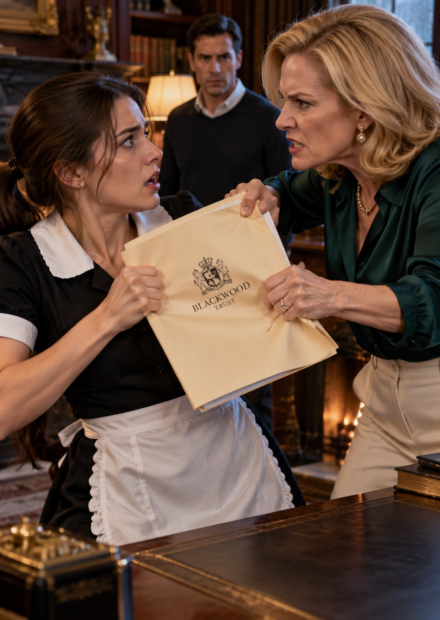
I reached for the bag.
She caught the strap.
“Please, don’t.”
That should have stopped me.
It didn’t.
The strap twisted between us.
She tried to pull it back.
I pulled harder.
The old stitching gave way.
The bag dropped.
It hit the marble.
Then everything spilled out.
Plastic containers skidded across the floor.
One struck my shoe.
Another spun beneath the narrow hallway table.
A sandwich wrapped carefully in two napkins rolled against the baseboard.
Three apples.
Two dinner rolls wrapped in paper.
A small container of roasted vegetables.
Slices of chicken.
Half a baked potato.
A sealed cup of soup.
Nothing from my office.
Nothing from the bedrooms.
Nothing expensive.
Nothing stolen.
Then three school notebooks fell from the bag.
They landed almost at my feet.
One was blue.
One red.
One black.
The corners were bent.
Children’s handwriting covered the front covers.
A multiplication table had been scribbled on the back of one.
On another, someone had drawn a crooked rocket ship.
The hallway became very quiet.
Tessa didn’t move.
Neither did I.
I looked down at the food.
Then at the notebooks.
Then at her.
“What is this?”
Her face collapsed.
Not dramatically.
That would have been easier to witness.
She simply seemed to lose the strength required to keep herself composed.
“My brothers.”
I stared at her.
“What?”
“The notebooks are my brothers’.”
I looked again at the food scattered between us.
“And this?”
Her mouth trembled.
She didn’t answer.
“Tessa.”
She covered her face with one hand.
“For them.”
The two words were almost inaudible.
The first edge of understanding touched me.
And I still didn’t understand enough.
“What do you mean, for them?”
She lowered her hand.
Her cheeks were wet.
“My brothers are waiting for me.”
Outside, freezing rain struck the windows.
The dinner bell rang somewhere deeper in the house.
Seven o’clock.
Right on time.
And while the rest of my employees walked toward a table covered in warm food, Tessa stood in front of me surrounded by plastic containers she had been carrying home in secret.
I looked at them again.
Then I asked the question that would stay with me for the rest of my life.
“What do you eat?”
Tessa’s eyes dropped to the marble floor.
She said nothing.
And suddenly, for the first time, I became afraid of the answer.