Chapter 1 – THE RAW RUBY ON THE DECK
The first thing I heard was my dress tearing.
Not Camille Vance laughing.
Not the shocked inhale of fifty people who had spent their entire lives pretending nothing could surprise them.
Not the soft clink of champagne crystal against polished teak.
The fabric ripping.
That was what stayed with me.
The seam of my navy linen dress split from the back of my shoulder almost to my waist with one sharp, vicious sound, like a sail snapping loose in a storm.
Three tiny bone buttons struck the deck near my feet.
One spun in a circle.
Another bounced beneath a white leather sofa.
The last slid beneath the bronze railing and disappeared into the black water of Biscayne Bay.
For one strange second, I watched it go.
Maybe because looking at the button was easier than looking at the people.
There were fifty guests aboard the Sovereign that evening, and almost every one of them was wealthy enough to buy the building where I worked without bothering to ask the price.
Oil heirs.
Shipping families.
Technology founders.
Private equity kings.
Women whose wedding rings had appeared in magazines.
Men who spoke about islands the way ordinary people spoke about restaurants.
All of them had been talking five seconds earlier.
Now nobody moved.
I reached behind myself with my right hand and caught the torn edges of my dress before the fabric could fall completely from my shoulders.
My left arm crossed my chest.
The Atlantic breeze touched the strip of bare skin running down my spine.
Cold.
Humiliating.
Unnecessary.
But humiliation was a strange thing.
It only became yours when you accepted the person humiliating you had the right to define you.
Camille Vance did not have that right.
So I lifted my chin.
And I looked at her.
She was still holding the diamond-tipped engraving stylus.
Its narrow metal point glittered beneath the deck lights.
Camille wore gold.
Of course she wore gold.
Her gown was covered in sequins that caught every light from the yacht and threw it back at the room, as if the evening itself had been arranged to reflect her. Three strands of perfectly matched South Sea pearls lay around her throat.
I knew those pearls.
I had rejected two hundred and seventeen others to create those three strands.
Camille did not know that.
Very few people did.
To most of the guests aboard the Sovereign, I was simply the quiet woman from the Miami jewelry house who had been stationed beside the private auction display.
A gem polisher.
A technician.
Staff.
Someone whose name did not matter.
That was deliberate.
I had spent years making sure of it.
Names attracted photographers.
Names attracted thieves.
Names attracted men who thought proximity to money made them important.
Stones were easier.
A ruby did not care who your father was.
An emerald did not change its internal structure because someone arrived in a limousine.
A diamond did not become less fragile because the hand holding it wore a watch worth more than a house.
Stone obeyed pressure, heat, cleavage, light.
It did not obey arrogance.
That was why I loved it.
And why Camille Vance had hated me from the moment I told her no.
Ten minutes earlier, she had walked toward my display carrying a glass of champagne and Julian Sterling on her arm.
Julian had looked bored.
He often did.
Boredom was part of the costume men like Julian wore when they wanted everyone around them to understand how difficult it was to impress them.
He was thirty-eight, handsome in the polished, expensive way some men became handsome after being photographed enough times.
Perfect tuxedo.
Silk bow tie.
Cuban cigar.
Smile that never reached his eyes.
His family had spent thirty years convincing Miami that the Sterling name meant old money.
I knew better.
Paper monarchs.
That was what I called them privately.
Their kingdom existed in prospectuses, investment reports, inflated valuations, borrowed yachts, and rooms full of people too embarrassed to admit they did not understand the numbers.
Julian had once spent twenty minutes explaining gemstone investing to me at a charity dinner.
He had not realized I was the woman who had cut three of the stones in the portfolio he was describing.
I had smiled the entire time.
Matteo had nearly broken a wineglass trying not to laugh.
Tonight, Julian did not recognize me at all.
That was not unusual either.
People who looked through servants rarely remembered their faces.
Camille stopped beside the velvet-lined display where the Burmese ruby waited beneath protective glass.
Five million dollars.
Forty-one carats after recutting.
Pigeon-blood color.
Minimal heat treatment.
A stone with the kind of red that did not look painted onto its surface but seemed to glow from somewhere deep inside itself.
I had spent six days studying it before touching a wheel.
Camille pointed at the case.
“Open it.”
I thought I had misheard her.
“Excuse me?”
“The ruby.”
Her lips curved.
“I want to see it.”
“You are seeing it.”
Julian laughed.
Camille did not.
“I want to hold it.”
“That won’t be possible until the inspection period begins.”
“I’m inspecting it now.”
“The auction protocol requires cotton gloves and a registered viewing appointment for unset stones.”
Camille took a sip of champagne.
“You know who I am?”
“Yes.”
That answer irritated her more than pretending ignorance would have.
She leaned closer.
“Then open the case.”
“No.”
I did not raise my voice.
That was the mistake people kept making with me.
They thought quiet meant uncertain.
Quiet had never meant uncertain.
Quiet meant I had already decided.
Camille looked around, perhaps expecting the nearest employee to hurry over and correct me.
Nobody did.
The floor supervisor was helping one of the collectors near the imperial tiara display.
Thomas Greene, the elderly jeweler who had taught me to sharpen my first polishing tool twenty years ago, was in the VIP stateroom checking an antique clasp.
For several seconds, it was simply Camille and me.
And the ruby.
Her smile sharpened.
“I could buy that stone tonight.”
“You could.”
“I could buy this entire display.”
“Possibly.”
“And you’re telling me I cannot touch something I’m considering purchasing?”
“I’m telling you nobody touches an unset five-million-dollar ruby with bare fingers during an auction preview.”
Julian exhaled smoke toward the bay.
“Camille.”
He sounded amused.
That made everything worse.
He was not trying to stop her.
He was encouraging the performance.
Camille put down her champagne.
Then she reached for the gem box.
I moved first.
My hand came down over the lid.
“Please don’t.”
Her eyes went flat.
“Take your hand away.”
“No.”
She grabbed the tray.
I held it.
The velvet case tilted perhaps two inches.
That was enough for a polishing cloth beside it to slide toward her sleeve.
A microscopic trace of rouge brushed the gold fabric near her wrist.
Camille stared at the mark.
It was barely visible.
A pink whisper against sequins.
But the room had already begun watching us.
Her humiliation required an audience.
So she created one.
“You idiot.”
I released the tray carefully and stabilized the ruby.
“The stone is secure.”
“My dress.”
“The rouge can be removed.”
She stared at me.
Then at the tiny mark.
Then back at me.
“You could spend fifty lifetimes in your gutter and not afford a single thread of this dress.”
Several people heard her.
A few looked away.
One woman near the champagne table pressed her lips together.
Nobody intervened.
I had seen that look before.
The look of people calculating whether morality was worth social inconvenience.
Usually it was not.
“I apologize for the contact,” I said. “But the protocol still stands.”
“You apologize?”
Camille smiled.
“Do you?”
“Yes.”
“Say it properly.”
“I just did.”
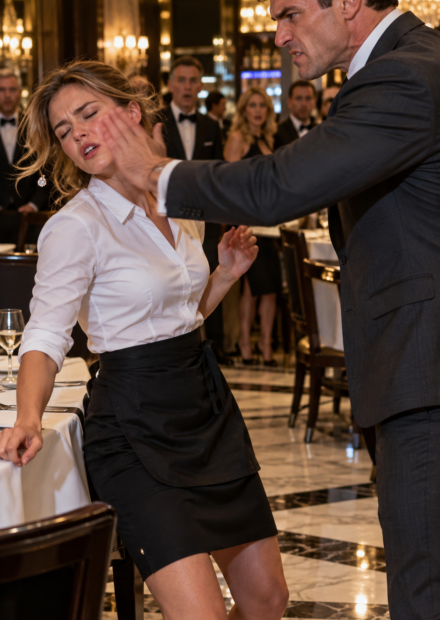
Her hand moved so quickly that I did not understand what she had taken until I saw the flash of metal.
The engraving stylus.
Diamond-tipped.
Sharp enough to score sapphire.
“Camille.”
Julian said her name this time.
Still not like a warning.
More like a man watching entertainment become unexpectedly interesting.
She stepped behind me.
I turned.
Too slowly.
The point caught the shoulder seam.
Then she dragged it down.
My dress opened.
The deck fell silent.
Camille lowered the stylus and smiled at me.
“That will teach you to refuse a guest who owns you.”
Something inside me became completely still.
Not broken.
Still.
There is a moment when a gemstone reaches the wheel and the entire process depends on one decision.
Press too lightly, nothing changes.
Press too hard, months of work can disappear in a fracture.
The person cutting the stone must know exactly how much force is enough.
I looked at Camille and understood that same principle applied to people.
Her power existed because everyone around her had spent years applying too little pressure.
She had never learned where the edge was.
I tightened my grip on my dress.
Behind her, cameras had risen.
Of course they had.
Luxury journalists.
Society photographers.
A lifestyle streaming channel.
Someone was already recording.
Camille turned slightly, giving them her better side.
Julian stepped forward.
He took another drag from his cigar.
“Camille is right.”
For the first time that evening, I felt something close to anger.
Not because he defended her.
Because of how ordinary his voice sounded.
As if what she had done was boring.
As if I were boring.
“Staff who can’t show proper deference to clients shouldn’t be aboard a private vessel,” he continued. “Have the tender take her back to the marina.”
I looked at him.
Really looked.
He had no idea who I was.
That should have amused me.
Instead, it made me tired.
A woman behind him whispered, “Julian…”
He ignored her.
The floor supervisor finally appeared at the edge of the gathering.
Before he could speak, Thomas came hurrying from the VIP corridor.
He was seventy-three.
Thin.
White-haired.
His hands shook slightly now when he carried coffee, though never when he held a jewel.
He took one look at my torn dress.
His face changed.
“Maeve.”
He grabbed a heavy linen tablecloth from a nearby service station.
“Miss Maeve, let me wrap this around you.”
He had almost reached me when Camille stepped forward.
She kicked the cloth out of his hands.
It fell onto the deck.
“Touch that cloth,” she said, “and your workshop loses its vendor license tomorrow, old man.”
That was the moment my anger sharpened.
Humiliate me if you need an audience.
Threaten me if your ego requires it.
But Thomas?
Thomas had spent fifty years at a bench.
He had repaired Fabergé enamel nobody else would touch.
He had worked through arthritis until his knuckles became mountains.
When I was nineteen and too proud to admit I had ruined an opal, Thomas had sat beside me until two in the morning and shown me how to salvage it.
Camille did not get to use him as scenery.
“Camille.”
My voice was quiet.
She turned.
“Step away from Thomas.”
She laughed.
The sound was bright and cruel.
“And what are you going to do, little lapidary?”
She lifted her hand.
“You’re a peasant with a torn dress.”
Her palm moved toward my shoulder.
I saw it coming.
I could have stepped back.
I did not.
Then a voice came from the salon doorway.
“If your hand moves another inch, captain, you will cut her fingers off or I will blow this yacht out of the water.”
Nobody breathed.
I knew that voice.
I had heard it whisper Italian into my hair at two in the morning.
I had heard it argue with port officials in three languages.
I had heard it say my name in anger exactly twice during our marriage.
I had heard it go cold enough to terrify men who believed they were incapable of fear.
I closed my eyes for half a second.
Matteo.
When I opened them, Camille’s hand was hanging in the air.
Every face on the deck had turned toward the main salon.
Matteo De Luca stood beneath the chrome doorway.
My husband did not enter rooms gently.
Even when he intended to.
He was forty years old, broad through the shoulders, dressed in a black double-breasted tuxedo with the white silk collar beneath it slightly open.
His hair had been pushed back from his forehead by the wind.
His expression was almost calm.
That was worse.
Three uniformed port authority captains stood behind him beside the harbor master.
None of them looked happy to be there.
Matteo looked at nobody except me.
Not Camille.
Not Julian.
Not the cameras.
Me.
The crowd opened for him.
Actually opened.
People who owned skyscrapers moved backward.
A hedge-fund billionaire nearly stepped on a waiter.
Julian’s cigar slipped from his fingers.
It struck the deck and rolled once before dying near the leg of a chair.
Camille lowered her hand.
The color drained out of her face.
Matteo stopped in front of me.
For a moment, he said nothing.
His eyes moved over my shoulder.
The torn fabric.
The skin exposed beneath it.
The stylus in Camille’s hand.
Thomas standing beside the fallen tablecloth.
Something changed in Matteo’s face.
Not much.
Someone who did not know him would have missed it.
I did not.
The muscles beside his jaw tightened.
His left thumb flexed once.
Danger.
He removed his tuxedo jacket.
“Turn around,” he said softly.
I did.
He placed the jacket over my shoulders with a care so gentle it made the humiliation hit me harder than the cruelty had.
Warm silk lining touched my skin.
The jacket smelled faintly of cedar, sea salt, and the cologne I had bought him the previous Christmas.
He brought the lapels around me.
Buttoned the front himself.
His fingers were steady.
“Are you all right, Maeve?”
“I’m fine.”
His gaze rose to mine.
He knew when I lied.
“I am,” I insisted.
Then I looked past him at Camille.
“Just an uncivilized guest.”
The faintest change touched his mouth.
Not a smile.
Nothing close to it.
He lifted one hand and brushed a streak of jewelers’ rouge from my jaw with his thumb.
Then he kissed my forehead.
The deck remained absolutely silent.
When he turned, Camille took one involuntary step backward.
Julian stared at me as though my face had rearranged itself.
Matteo looked from one to the other.
Then at the rest of the guests.
“My wife designed every single piece of jewelry on this vessel.”
A woman dropped her champagne glass.
It shattered.
Nobody looked down.
Matteo continued.
“The ruby you tried to grab?”
His gaze rested on Camille.
“My wife recut it.”
Camille’s lips parted.
“The imperial tiara in the salon?”
His voice remained soft.
“She restored it.”
Julian looked at me.
“No.”
That single word almost made me laugh.
Not because it was funny.
Because denial was apparently all his mind could produce.
Matteo’s eyes shifted to him.
“Before this ship docks tonight, every person who raised a voice against her will beg for the right to breathe.”
“Matteo,” I murmured.
He heard me.
Of course he did.
But he was no longer looking at me.
He turned toward the captain of the Sovereign, who stood rigid near the upper-deck stairway.
“Captain.”
“Yes, Mr. De Luca.”
Matteo’s voice dropped until I nearly had to lean forward to hear him.
“Bring me a chair for my wife.”
The captain swallowed.
“Yes, sir.”
Matteo looked around the yacht.
At the chandeliers.
At the auction displays.
At the guests who had watched my dress be torn open and had done nothing.
Then he added, almost conversationally,
“Before I sink this ship.”
No one laughed.
And for the first time since Camille had picked up that stylus, I realized the night was nowhere near over.