THEY CUT MY HAIR WHILE I SLEPT—THREE DAYS LATER, THEY LEARNED WHOSE HOUSE IT WAS
Chapter 1 – THE SOUND OF SCISSORS
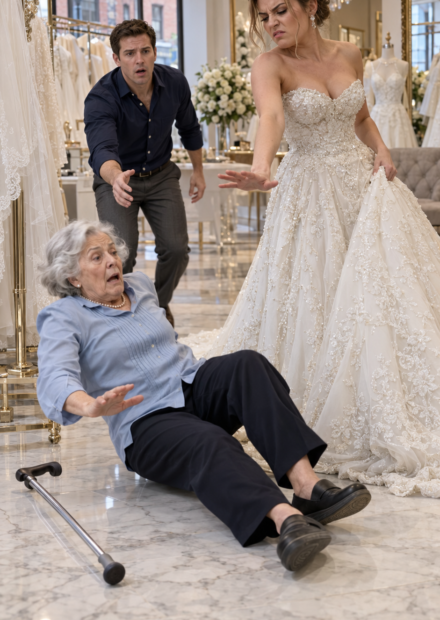
I woke to the sound of scissors hitting the hardwood floor.
For one confused second, I thought the noise had come from a dream.
Then I opened my eyes.
Morning light was slipping through the curtains beside my bed. My bedroom door stood open. My daughter-in-law, Vanessa, was beside me wearing a satisfied smile.
My son Daniel leaned against the doorway.
Neither of them looked surprised that I was awake.
Neither looked ashamed.
I pushed myself upright.
Something brushed against my arm.
Hair.
A long strand of dark brown hair slid from my shoulder and fell across the blanket.
I froze.
Then I looked down.
There was hair everywhere.
Across my pillow.
On the comforter.
Scattered over the hardwood floor beside the bed.
Some strands were nearly two feet long.
For more than thirty years, my hair had fallen almost to my waist.
Now one side still hung past my shoulder while the other had been hacked away close to my ear.
I lifted a trembling hand to my head.
My fingers found jagged ends.
Uneven pieces.
Empty space where weight had always been.
My mind could not accept what my hand was telling it.
I looked at Vanessa.
“What did you do?”
She tilted her head.
The smile remained.
“Maybe now you’ll learn your place.”
For a moment, I could not breathe.
I looked toward Daniel.
My son.
My only child.
Forty years old.
The boy I had once stayed awake beside for two nights when pneumonia made his breathing frighteningly shallow.
The teenager whose college applications I had proofread at midnight.
The man whose failed business had brought him back under my roof three months earlier.
“Daniel?”
I did not recognize my own voice.
I expected something.
Shock.
Regret.
A sudden realization that whatever argument we had been having had gone too far.
Instead he shrugged.
“You needed this lesson, Mom.”
Those words hurt more than the hair.
More than Vanessa’s smile.
More than waking to find part of myself scattered across the floor.
I stared at him.
He stared back.
And in that moment I understood something no mother wants to understand about her own child.
He had watched.
Whatever Vanessa had said before entering my room, whatever plan they had made, whatever excuse he had given himself, Daniel had stood there while his wife cut my hair as I slept.
He had watched her humiliate me.
And afterward, when I woke horrified, he believed I deserved it.
Vanessa folded her arms.
“Maybe now you’ll stop acting like you’re the queen of this house.”
My eyes burned.
I would not cry in front of them.
Not because tears were weakness.
I had learned better than that.
I would not cry because Vanessa was waiting for them.
She wanted proof that she had reached me.
She wanted the broken expression.
The pleading.
The outrage she could later describe as another example of how “dramatic” I was.
So I looked down instead.
The scissors lay near my bare foot.
Silver blades.
Black plastic handles.
Ordinary household scissors.
Mine, I realized.
They came from the drawer in my downstairs desk.
I bent slowly and picked them up.
Daniel’s smile faded slightly.
Vanessa shifted her weight.
I turned the scissors once in my hand.
Then calmly placed them on my nightstand.
“You know what?” I said.
Vanessa’s eyebrows lifted.
“You’re right.”
Her mouth curled upward.
Someone here did need to remember their place.
Daniel smirked.
He thought I meant myself.
I stood.
The uneven side of my hair brushed my cheek.
I could feel the longer half against my back.
The difference between the two sides was so extreme that walking past the mirror almost made me stumble.
I did not look again.
Not yet.
“I need to get dressed.”
Vanessa laughed softly.
“There. Was that so hard?”
I looked at her.
“What?”
“Accepting reality.”
I said nothing.
Daniel pushed away from the doorframe.
“Come on, Vanessa.”
He sounded almost cheerful.
As they left, she glanced once at the hair on the floor.
She did not offer to clean it.
Of course she did not.
The door closed behind them.
I locked it.
Then I went into the bathroom.
Only after the second lock clicked did my knees begin shaking.
I gripped the sink.
Raised my head.
And looked into the mirror.
I had prepared myself for bad.
I had not prepared myself for cruel.
One side of my hair was still long and familiar.
The other looked as if someone had cut it while angry.
Which, of course, someone had.
Short pieces stuck out near my ear.
A section above my jaw was almost three inches shorter than everything around it.
I touched it.
My face crumpled.
I cried.
I cried for the hair first.
People may think that sounds shallow.
Hair grows back.
I knew that.
But grief is rarely logical.
Richard had loved my hair.
My husband and I were married for thirty-six years.
For most of those years, he teased me that my hair was the one thing about me he was forbidden to criticize.
Whenever I threatened to cut it short, he would put both hands over his heart and pretend to collapse.
“Margaret, think of the marriage.”
I would laugh.
“You married me, not my hair.”
“I’m not convinced the vows were that specific.”
Near the end, when pancreatic cancer reduced the strongest man I knew to a body that tired after crossing a room, Richard still loved brushing my hair.
Some evenings, after chemotherapy left him too nauseated to eat, I would sit on the floor in front of his chair.
He would take the brush.
Slowly.
Carefully.
Sometimes his hand shook.
Sometimes he had to stop halfway.
But he would brush from the crown of my head to the ends.
Then he would say, “There.”
As though he had fixed something.
As though one ordinary act could make our frightening life normal for five minutes.
Richard died five years ago.
I had considered cutting my hair many times since.
I never did.
Keeping it long was not a promise.
It was not even something I had consciously decided.
It simply remained.
Like his watch in my dresser.
His books in the study.
His favorite chair beside the window.
His blue ceramic coffee mug with the small chip near the handle.
Except the mug was gone now.
Vanessa had thrown it away.
That happened during their second month living with me.
Daniel’s business had collapsed in late summer.
He had tried opening a specialty home-renovation supply company with a partner. They borrowed heavily, expanded too quickly, and lost several major customers in the same quarter.
By the time Daniel finally called me, the business was finished.
He and Vanessa were three months behind on their mortgage.
Their savings were nearly gone.
They listed their townhouse, sold it before the bank situation became worse, and needed somewhere temporary while Daniel looked for stable work.
“Just a little while,” he said.
I had four bedrooms.
I lived alone.
Of course I said yes.
That phrase had caused more trouble in my life than almost any other.
Of course.
Of course I would help my son.
Of course they could stay.
Of course they did not need to pay rent while they recovered.
Of course I would cover groceries for a while.
Of course they could use the guest suite.
Of course family helped family.
At first, I meant every yes.
I was happy to help.
Daniel was ashamed of the failed business.
I could see that.
For the first two weeks, he barely left the guest room before ten.
He stayed on his laptop applying for jobs.
He became quiet.
Vanessa tried to stay upbeat.
She cooked twice.
Bought flowers for the kitchen.
Thanked me for letting them stay.
I remember telling Richard’s photograph one evening, “They’ll be okay.”
I believed it.
Then small things changed.
Vanessa began rearranging my kitchen.
Not one drawer.
Everything.
I came downstairs one morning and spent fifteen minutes looking for the coffee filters.
She had moved them from the cabinet beside the coffee maker to the pantry.
“Why?” I asked.
“The layout made no sense.”
“To whom?”
She laughed.
“Margaret, you have a huge kitchen. You’ve been using it like an old lady.”
I was sixty-one.
Not ninety-one.
And even at ninety-one, I hoped I would still have the right to decide where my coffee filters belonged.
I moved them back.
The following week she replaced three decorative pillows in my living room.
Then a side table.
Then two lamps.
I walked downstairs one afternoon and found the armchair Richard had chosen twenty years earlier pushed into the hallway.
“What’s happening?”
Vanessa looked up from her phone.
“I’m updating things.”
“No.”
She frowned.
“No what?”
“No updating things without asking me.”
“The furniture is dated.”
“It is my furniture.”
She sighed.
“You don’t need to take everything personally.”
I looked at Daniel.
He was sitting at the dining table with his laptop.
He did not lift his eyes.
“Daniel?”
He finally looked up.
“What?”
“Did you know about this?”
He shrugged.
“She’s just trying to help.”
There it was.
The first small betrayal.
Not the worst.
Not even close.
But the pattern started there.
Whenever Vanessa crossed a boundary, Daniel translated it into something harmless.
Changing furniture became helping.
Moving my belongings became organizing.
Throwing something away became decluttering.
Speaking sharply became stress.
Inviting people into my house without asking became Vanessa needing a social life.
Every conflict ended with me being encouraged to “let it go.”
I let too much go.
Then came Richard’s mug.
I used to keep it on a shelf beside the coffee machine.
Blue ceramic.
White lettering that read WORLD’S OKAYEST GOLFER.
Sarah—my sister, not a child; I don’t have a daughter—had given it to Richard as a joke one Christmas because Richard believed he was a better golfer than any scorecard had ever proved.
After he died, I did not use it.
I simply liked seeing it.
One morning, it was gone.
I checked the dishwasher.
Cabinets.
Sink.
Vanessa finally said, “Oh, that ugly blue thing?”
I turned.
“What?”
“I threw it out.”
My body went cold.
“You what?”
“It had a chip in it.”
I stared at her.
“It was Richard’s.”
“I know.”
“Then why would you throw it away?”
She looked genuinely confused.
“Because it looked cheap.”
That was her answer.
Because it looked cheap.
I went outside and checked the trash bins.
Garbage collection had already come.
I stood beside the empty bin with both hands pressed against the lid.
Daniel found me there.
When I told him what she had done, he said, “Mom, it was a mug.”
I remember looking at him and thinking that grief has a second death nobody warns you about.
The first is losing the person.
The second comes in small pieces, when other people stop understanding why their objects matter.
“It was your father’s.”
“I know.”
“So tell her she had no right.”
He rubbed his forehead.
“I’m not starting a fight over a coffee cup.”
I should have heard that sentence for what it was.
He was not refusing conflict.
He was choosing which person was allowed to absorb the loss.
He chose me.
Again.
Still, I told myself he was under pressure.
He had lost his company.
His home.
His sense of independence.
Vanessa was probably afraid too.
Family needed patience.
That became my excuse for everything.
Then Vanessa invited six friends to my house for dinner without telling me.
I came home from a book club meeting and found strangers drinking wine in my living room.
She introduced me by saying, “That’s Daniel’s mother. She’s the older relative who lives upstairs.”
I stopped walking.
One of her friends laughed politely.
Perhaps she thought Vanessa was joking.
Vanessa did not correct herself.
Older relative who lives upstairs.
In my house.
I was sixty-one.
And somehow, inside Vanessa’s version of our arrangement, I had become the elderly woman occupying the upper floor of a home she controlled.
That night I confronted Daniel.
He asked me to give Vanessa space.
“Space?”
“She lost her home too.”
“So she gets mine?”
“That’s not what I said.”
“No. It’s what you keep refusing to say.”
He became angry.
“You know what? Sometimes I think you enjoy making her feel like a guest.”
“She is a guest.”
His face changed.
That was the first time I realized the word offended him.
“After three months?”
“How long does someone have to live in my house before it stops being mine?”
“Mom.”
“No. Tell me.”
He walked away.
Nothing was resolved.
The next morning, he was cheerful again.
That was Daniel’s gift.
He could treat unresolved problems as if time had solved them.
I could not.
Then came the study.
Richard’s room.
The night before my hair was cut, I was walking down the hall when I noticed the study door open.
Vanessa was inside.
She had a measuring tape stretched across the wall.
For a second, I thought I was seeing something incorrectly.
“What are you doing?”
She barely glanced at me.
“Measuring.”
“For what?”
“We’re thinking about remodeling this room.”
I stepped inside.
“We?”
“Daniel and me.”
My chest tightened.
The study had changed very little since Richard died.
His books still lined the shelves.
His old desk sat beside the window.
A framed photograph from our twenty-fifth anniversary stood near the lamp.
I used the room.
I paid bills there.
Read there.
Sometimes simply sat in Richard’s chair when I missed him.
It was not a shrine.
It was part of my home.
And it was mine.
“No.”
Vanessa finally looked at me.
“No?”
“This room stays as it is.”
She laughed.
Not because I had said something funny.
Because she found the idea of me setting a limit ridiculous.
“You seriously need to stop living in the past.”
“That is not your decision.”
“You’re clinging to a dead man and a dead life.”
For a moment, I could not speak.
I heard Richard’s brush moving through my hair.
The quiet rasp of it.
His weak voice saying, There.
Something inside me hardened.
“I think it’s time for you to leave.”
Vanessa’s face changed.
“What?”
“You heard me.”
Daniel appeared in the hallway.
He had been close enough to hear.
Instead of asking what happened, he moved immediately toward Vanessa.
“This is exactly why nobody can live with you, Mom.”
I stared at him.
“My house. My room. My decision.”
Vanessa folded her arms.
“We’ll talk about this tomorrow.”
I should have noticed the confidence.
She did not ask whether we would talk.
She had already decided.
Apparently, she had also decided how that conversation would begin.
With scissors.
Now, locked inside my bathroom, I cried until my face hurt.
Then I washed it.
Twice.
I wet a towel with cold water and held it over my eyes.
When I finally looked into the mirror again, I still looked devastated.
But I also looked awake.
That was new.
For three months, I had been half asleep inside my own life.
Explaining.
Excusing.
Waiting for Daniel to become the son I recognized.
Waiting for Vanessa to develop gratitude.
Waiting for patience to work.
My hair on the floor downstairs had answered every question I had avoided.
They had mistaken patience for permission.
Every meal I paid for.
Every bill I covered.
Every room I opened.
Every boundary I softened.
They had not seen kindness.
They had seen weakness.
I dried my face.
Then I opened the bathroom door.
I took photographs.
My hair from both sides.
The floor.
The scissors.
The strands on the pillow.
The open bedroom doorway.
My hands were steadier now.
And then I remembered something Vanessa clearly had not.
Two years earlier, after someone attempted to break into the house while I was visiting my sister, I had installed security cameras.
Outside.
Downstairs.
And in the upstairs hallway.
One camera covered the landing and the entrance to my bedroom.
I opened the security application.
Found the morning recording.
My finger hovered over the screen.
Then I pressed play.
At 6:11 a.m., Vanessa appeared in the hallway.
She looked directly toward my bedroom.
Scissors in her hand.
Daniel followed.
My stomach twisted.
Vanessa entered first.
Daniel stayed near the doorway.
For almost nine minutes, the camera captured movement through the open bedroom entrance.
Not every cut.
The angle did not show the entire bed.
It did show Vanessa repeatedly stepping close to me and withdrawing with long pieces of hair in her hand.
It showed Daniel watching.
At one point, Vanessa turned toward him.
He laughed.
Actually laughed.
I stopped the video.
Started it again.
Saved it.
Downloaded it.
Sent copies to two separate email accounts.
Uploaded another to cloud storage.
Then I sat on the edge of the bed.
There was no misunderstanding left.
No version Daniel could soften.
No explanation Vanessa could reshape.
I opened my contacts.
Scrolled.
Stopped at a name I had not called in several months.
Martin Aldridge, Attorney.
I pressed the number.
He answered on the third ring.
“Margaret?”
“Mr. Aldridge.”
There was a pause.
Then his voice became more serious.
“What happened?”
I looked at myself in the bedroom mirror.
Uneven hair.
Swollen eyes.
My husband’s photograph on the dresser behind me.
“I think it’s time.”
Silence.
Only a second.
But enough to tell me he remembered exactly what I meant.
“Are you certain?”
Three months earlier, I had asked him what it would take to legally end Daniel and Vanessa’s stay in my house if things became unbearable.
I had not been ready then.
I was ready now.
I looked toward the bedroom door where my son had stood and watched.
“Completely.”