SHE POURED CHAMPAGNE ON THE WAITRESS—THEN I MADE ONE PHONE CALL
Chapter 2 – THE NAME SHE SHOULD HAVE RECOGNIZED
There are moments when a crowded room becomes so quiet that silence starts to feel physical.
That was one of them.
My father stood beside me beneath a chandelier large enough to hang in a cathedral.
Across the ballroom, Victoria Langley stared at us.
Her champagne glass was halfway to her lips.
She didn’t drink from it.
She didn’t move at all.
I could almost see the pieces connecting in her mind.
Emily Reed.
Nathan Reed.
The foundation.
The special guest.
The Medal of Honor.
Dad.
I had never believed my last name should determine how someone treated me.
Apparently Victoria had.
She just hadn’t realized she had the wrong information.
My father repeated the question.
“Emily.”
His voice was calm.
“Is that the woman?”
Every instinct inside me told me to say no.
Not because I wanted to protect Victoria.
Because I knew what happened when my father was angry on my behalf.
He didn’t shout.
He didn’t threaten.
He asked questions.
That was much worse.
“Dad, maybe we should talk outside.”
His eyes stayed on Victoria.
“Did she pour the drink on you?”
People nearby were pretending not to listen.
They were doing a terrible job.
I swallowed.
“Yes.”
He nodded once.
Then he looked at me.
“And what happened before that?”
“Nothing.”
“Nothing?”
“She called me over for champagne. I served her. She said I interrupted her conversation.”
“Did you?”
“No.”
“Did you say anything insulting?”
“No.”
“Did you touch her?”
“No.”
“Did you spill anything on her?”
“No.”
His jaw tightened.
Behind him, the foundation chairman, a gray-haired man named Charles Benton, approached carefully.
“Nathan.”
My father glanced toward him.
Charles looked from me to Victoria.
“I heard there was some kind of incident.”
Victoria finally found her voice.
“This is ridiculous.”
Every head near us turned toward her.
She recovered quickly.
People like Victoria often do.
Fear crossed her face for only a moment before pride covered it.
She placed her glass on a passing tray and walked toward us.
“Nathan,” she said, smiling tightly, “I had absolutely no idea this was your daughter.”
My father stared at her.
“Would it have mattered?”
The question landed harder than any insult.
Victoria’s mouth opened.
Closed.
“I simply mean—”
“I know what you meant.”
Her cheeks flushed.
“This situation is being completely blown out of proportion.”
I felt every eye in the room move toward me.
I hated it.
I didn’t want to become entertainment again.
First as the humiliated waitress.
Now as the powerful man’s daughter.
Neither version felt like me.
So I stepped forward.
“Then explain it.”
Victoria looked at me.
“What?”
“If it’s being blown out of proportion, explain what actually happened.”
Her eyes hardened.
“Emily, I don’t think this is the appropriate place—”
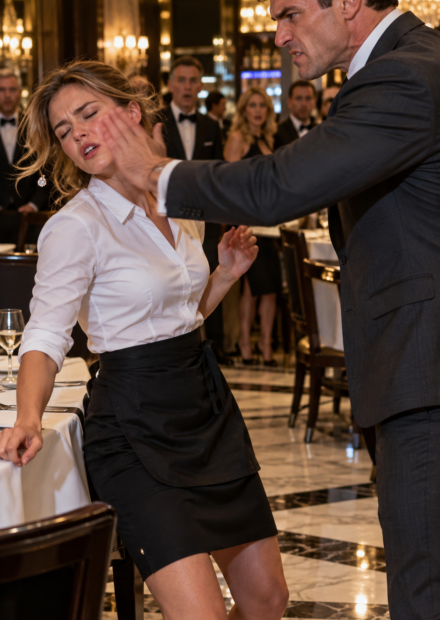
“You thought it was the appropriate place when you poured champagne over me.”
A few people exchanged glances.
My father’s head turned slightly toward me.
He said nothing.
That mattered.
He wasn’t taking control.
He was letting me speak.
Victoria noticed too.
“You’re clearly upset,” she said.
“I am.”
“And I understand that.”
“No. You don’t.”
She inhaled slowly.
“Perhaps I reacted badly.”
“Reacted to what?”
Silence.
Victoria looked around.
She had made a mistake.
A serious one.
She had expected me to attack her character.
Expected tears.
Anger.
Maybe an accusation she could dismiss as emotional.
Instead, I had asked a simple question.
Reacted to what?
There was no good answer.
Because I had done nothing.
Charles Benton looked uncomfortable.
“Victoria?”
She turned toward him.
“She was rude.”
“How?”
Victoria hesitated.
“I called her over, and she had an attitude.”
“What did she say?” my father asked.
Victoria looked at him.
“I don’t remember the exact words.”
“I do,” someone said.
We all turned.
The man who had been standing behind Victoria earlier stepped forward.
He was in his late fifties, thin, with wire-framed glasses.
He looked vaguely familiar.
“I was standing close enough to hear the conversation,” he said.
Victoria’s face tightened.
“Michael.”
He ignored her.
“Ms. Reed asked whether Mrs. Langley needed anything else. Mrs. Langley said she had interrupted the conversation. Ms. Reed apologized.”
My father looked at me.
I didn’t speak.
Michael continued.
“Then Mrs. Langley accused her of sarcasm.”
“She was sarcastic,” Victoria snapped.
Michael’s expression didn’t change.
“I didn’t hear sarcasm.”
“Well, you weren’t the one she was speaking to.”
“No. I was simply the one listening.”
Victoria turned toward Charles.
“This is absurd.”
Michael wasn’t finished.
“Then Ms. Reed said she was trying to do her job.”
My father asked, “And then?”
Michael looked directly at Victoria.
“Mrs. Langley poured the champagne over her.”
Whispers moved through the room.
Not the whole ballroom.
But enough.
Victoria’s composure cracked.
“You’re making it sound malicious.”
Michael looked genuinely puzzled.
“You poured an entire glass over her.”
“It was a joke.”
I stared at her.
That sentence hurt more than I expected.
A joke.
I remembered the cold champagne running down my neck.
The laughter.
The way she watched my eyes fill with tears.
I stepped closer.
“Who was supposed to laugh?”
Victoria looked at me.
“What?”
“You said it was a joke. Who was supposed to laugh?”
She had no answer.
“My uniform was soaked. I was humiliated in front of a room full of people. You knew I couldn’t respond because I was working.”
“That wasn’t—”
“You knew I had to stand there.”
My voice shook now.
I hated that it shook.
But I continued.
“You knew if I yelled at you, I could lose my job. You knew if I poured a drink back on you, I would be thrown out. You knew I couldn’t defend myself the same way you could attack me.”
Victoria glanced toward my father.
That was the moment everything changed for me.
Because she still wasn’t looking at me.
Not really.
She was looking at him.
At the consequences.
She wasn’t sorry that she had humiliated a waitress.
She was afraid she had humiliated Nathan Reed’s daughter.
My anger became clearer.
Colder.
“So I’ll ask you one thing.”
Victoria looked back at me.
“If my father hadn’t walked into this room, would you be apologizing?”
Her face answered before her mouth did.
“No,” I said quietly. “You wouldn’t.”
“Emily,” she began.
“Don’t.”
For the first time, I didn’t call her ma’am.
“Don’t apologize because of him.”
Her eyes flashed.
“I was about to apologize.”
“No, you weren’t.”
“You don’t know that.”
“I came back into this room. You saw me. You smiled.”
The words landed between us.
Victoria’s face went still.
I hadn’t intended to say it.
But once I did, I realized how important it was.
She had smiled.
After humiliating me.
After seeing me return with wet hair.
She had smiled because she thought she had won.
My father finally spoke.
“Charles.”
The foundation chairman straightened.
“Nathan.”
“I’d like to understand something.”
“Of course.”
My father’s gaze moved around the ballroom.
The banners.
The photographs of soldiers.
The words painted in gold beside the stage:
HONOR. SERVICE. DIGNITY.
“This foundation asked me to speak tonight about dignity.”
No one moved.
“I find that interesting.”
Charles looked miserable.
“Nathan, I assure you—”
“I’m not blaming you for one guest’s behavior.”
Victoria’s shoulders relaxed slightly.
Too soon.
“But I am asking what happens now.”
Victoria stepped forward.
“This was a misunderstanding.”
My father looked at her.
“No.”
His voice wasn’t loud.
“No, it wasn’t.”
She stared at him.
“A misunderstanding is when two people reasonably interpret the same situation differently. You intentionally poured a drink over a person who was serving you.”
Victoria crossed her arms.
“With respect, Nathan, you weren’t here.”
“No.”
He nodded toward Michael.
“But he was.”
Michael gave a small nod.
“And so were at least eight other people.”
Several guests suddenly became fascinated by their shoes.
My father noticed.
“So perhaps we should stop pretending there is uncertainty.”
Victoria’s husband appeared then.
I hadn’t met him before.
Richard Langley.
He moved quickly from the other side of the ballroom.
He looked worried.
Not angry.
Worried.
“Victoria, what happened?”
She turned toward him.
“Nothing.”
My father said, “Your wife poured champagne over my daughter.”
Richard stopped.
He looked at me.
Then at Victoria.
“You did what?”
Victoria lowered her voice.
“Richard.”
“Did you?”
“It was a joke.”
His face changed.
Not dramatically.
But enough.
“You poured champagne on a member of the staff?”
The way he said staff bothered me.
Even now.
Even knowing who I was.
So I corrected him.
“On me.”
Richard looked at me.
“I’m sorry.”
At least his apology sounded real.
Victoria’s didn’t.
My father watched both of them.
Then Charles said quietly, “Victoria, I think you should leave.”
Her head snapped toward him.
“Excuse me?”
“We’ll discuss the board matter later.”
Her face drained of color.
“Board matter?”
“Not here.”
“No. If you’re implying that this affects my position—”
Charles’s voice hardened.
“You are a member of donor relations at a foundation built around service and dignity. Tonight you publicly humiliated someone who was working at our event.”
“I donate more money to this organization than most people in this room.”
My father almost smiled.
There it was.
The truth.
Money.
Status.
Immunity.
Victoria heard herself too late.
Charles stared at her.
“So that makes it acceptable?”
“I didn’t say that.”
“You came very close.”
She looked toward my father.
“Nathan, surely we’re not going to turn one unfortunate moment into some moral crusade.”
My father looked at me.
Then back at her.
“No.”
He paused.
“My daughter already made the moral point.”
My heart thudded.
He continued.
“I’m concerned with something simpler.”
Victoria waited.
“Accountability.”
Her jaw tightened.
Richard touched her arm.
“Victoria, we should go.”
She pulled away.
“No.”
Everyone around us had stopped pretending they weren’t watching.
The humiliation she had given me was now circling back toward her.
And for one dangerous second, I enjoyed it.
That frightened me.
I didn’t want to become her.
So I stepped toward my father.
“Dad.”
He looked at me.
“I want to leave.”
His expression softened.
“Okay.”
Victoria laughed bitterly.
“That’s it?”
I turned.
She looked angry now.
Actually angry.
Not because she had hurt me.
Because the room no longer belonged to her.
“You call your father,” she said, “and suddenly everyone treats this like I’ve committed some horrible offense?”
I stared at her.
“No.”
“What?”
“I called my father because I was upset and wanted to go home.”
She scoffed.
“You expect me to believe you had no idea he was coming here?”
“I didn’t.”
“Please.”
“I didn’t even know he was the special guest.”
Victoria looked toward my father.
Then back to me.
She didn’t believe me.
That was fine.
“I wasn’t trying to punish you,” I said.
“Then what do you call this?”
I looked around the room.
“This?”
I almost laughed.
“This is what happens when the person you mistreat turns out to have someone powerful standing behind her.”
Victoria’s expression sharpened.
“And that’s fair?”
“No.”
That answer surprised her.
“It isn’t fair.”
The ballroom remained silent.
I continued.
“Because if my father were a mechanic, or a teacher, or unemployed, or dead, you still would have been wrong.”
Victoria said nothing.
“If I’d had nobody to call, you still would have been wrong.”
I felt my throat tighten.
“If I had gone into that staff room, cried for ten minutes, changed my shirt, finished my shift, and never seen you again, you still would have been wrong.”
No one interrupted me.
“That’s what you don’t understand.”
Victoria’s eyes moved around the room.
For the first time, she seemed to realize there was nowhere to hide inside her own status.
I picked up the stained white shirt I had carried from the service hall.
The champagne mark had turned pale gold under the lights.
“This shouldn’t matter more because of who my father is.”
I held it between us.
“It should matter because of what you did.”
I placed the shirt on the edge of the service table.
Then I looked at Thomas.
“Can I go?”
He nodded immediately.
“Of course.”
Victoria watched me.
And I thought that was the end.
I was wrong.
Because as my father and I reached the ballroom doors, Charles Benton called after us.
“Nathan.”
We turned.
Charles looked at me.
Then at my father.
“Your speech.”
Dad glanced at the stage.
Then at me.
“I think I already gave it.”
A murmur passed through the guests.
My father put his hand gently between my shoulders.
We walked toward the exit.
But before the doors closed behind us, I heard Victoria say something that stopped me cold.
“This is going to destroy me over one stupid waitress.”
I turned around.
She realized immediately that I had heard her.
So had everyone else.
One stupid waitress.
My father started to move.
I touched his arm.
“No.”
He looked at me.
I walked back into the ballroom alone.
Because suddenly I didn’t want to leave anymore.