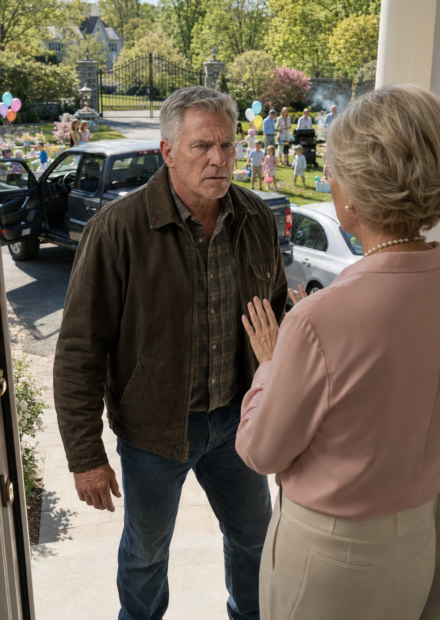
THEY THREW ME OUT—THEN BOARDED MY SHIP
Chapter 2 – THE ROOM I PAID FOR
The night my son threw me out, Lillian had already packed one of my suitcases.
That was how I knew the argument had begun before I entered the room.
My navy suitcase stood beside the front door.
One zipper was open.
A sleeve from one of my sweaters hung halfway out like a hand trying to stop itself from being carried away.
Daniel stood near the staircase.
Lillian stood beside the dining table.
Neither looked surprised when I walked in.
I closed the door quietly.
“What happened?”
Lillian folded her arms.
“We need to talk.”
People rarely say that when they intend to listen.
I set my purse on the console table.
It was raining outside.
Water ticked against the windows in light, impatient taps.
I had spent most of the afternoon reviewing vessel inspection summaries on my laptop at the library because Daniel had been working from home and complaining that my calls disturbed him.
The acquisition audit for Meridian Crown was in its final stage.
I had been under a strict confidentiality agreement for almost seven months.
Daniel knew I did consulting work.
He did not know for whom.
He had stopped asking years earlier.
To him, my work was something vague that happened on a computer.
Something older women did when they did not understand retirement.
I looked again at the suitcase.
“Why are my things by the door?”
Daniel rubbed the back of his neck.
“Mom, just listen first.”
Those words frightened me more than anger would have.
Daniel had inherited his father’s habit of rubbing his neck when he was ashamed.
After my husband, Thomas, died, I learned to recognize the difference between Daniel being angry with me and Daniel knowing he was hurting me.
Anger made him loud.
Shame made him careful.
I had moved into Daniel and Lillian’s house twenty-six months earlier.
It was supposed to be temporary.
After Thomas died, the home we had shared for thirty-four years became unbearable in ways I could not explain.
His shoes were still beside the back door.
His coffee mug remained on the second shelf.
Every room had a sound missing from it.
When Daniel offered me the spare bedroom, I refused twice.
The third time, he said, “Mom, stop pretending you have to do everything alone.”
I believed him.
Perhaps that was my first mistake.
Not moving in.
Believing the invitation meant I would always be family before I was useful.
From my first month in the house, I paid rent.
Daniel protested initially.
I insisted.
Nine hundred dollars on the first of each month.
Every month.
I paid for half the groceries.
I handled the electric bill twice when Daniel’s consulting income dropped.
I covered a plumbing repair.
When their SUV died, I gave Daniel the down payment for a replacement because he needed reliable transportation for work.
When they married, I gave them money toward the wedding because they had chosen a small ceremony and told me they wanted to avoid debt.
I never kept score.
At least, I did not think I did.
But I kept records.
That was different.
I had spent most of my adult life in compliance.
Records were how you separated memory from fact.
Daniel used to tease me about it.
“You save receipts for breathing.”
And I would answer, “Only if breathing becomes tax-deductible.”
That night, none of it felt funny.
Lillian tapped a manicured finger against her arm.
“We’re not doing this anymore.”
“Doing what?”
“This arrangement.”
I looked at Daniel.
He stared at the floor.
“What arrangement?”
“You living here.”
I waited.
I think part of me expected Daniel to laugh.
To say Lillian was angry and they had gotten carried away.
He did not.
Instead, he said, “Things have become tense.”
“Tense.”
“Yes.”
“Because I refused to give you thirty-eight thousand dollars?”
Lillian’s eyes sharpened.
“There it is.”
I looked at her.
“There what is?”
“The way you always make everything about money.”
I almost admired the sentence.
It was so completely upside down that for a moment I could not answer.
Three days earlier, Daniel and Lillian had sat with me at the same dining table and shown me the brochure for their cruise.
Twelve nights.
A balcony suite.
Premium dining.
Private excursions.
A luxury package that included airport transfers, spa access, and something called an “exclusive coastal experience” that appeared to involve drinking champagne on a boat smaller than the boat carrying you to the boat.
They had booked months earlier.
I knew that.
What I had not known was that they expected me to help pay the final balance.
Daniel called it a family gift.
Lillian called it “helping us finally have something nice.”
I reminded her about the SUV visible from the window.
That had not gone well.
Daniel said they were under temporary pressure.
Lillian said they deserved the trip because the previous year had been stressful.
I asked why they had booked something they could not comfortably afford.
That was apparently cruel.
Then Daniel said the sentence I had spent three nights hearing in my head.
“You have the money, Mom.”
Not Can you help?
Not Would you consider it?
You have the money.
As if the location of money determined ownership.
I had told them no.
I told them my savings were for my retirement, my housing, and emergencies.
Daniel reminded me that one day whatever remained would probably come to him anyway.
I remember staring at my son after he said it.
“Probably?”
He had realized too late what the word meant.
“Mom, I didn’t mean—”
“I’m still alive, Daniel.”
“Of course you are.”
“Then stop budgeting my death.”
That should have ended the discussion.
Instead, it began the countdown.
Now my suitcase stood by the door.
Lillian looked at me.
“You’ve made living here unbearable.”
“By saying no?”
“By judging us.”
“I asked why you committed to a thirty-eight-thousand-dollar expense you could not cover.”
“That is judgment.”
“That is arithmetic.”
Her face reddened.
Daniel raised one hand.
“Can we not do this?”
I turned to him.
“What exactly are we doing?”
He exhaled.
“Mom, maybe you should stay somewhere else for a while.”
“How long?”
“I don’t know.”
“A week?”
“Mom.”
“A month?”
He said nothing.
My eyes moved toward the suitcase again.
My stomach tightened.
“This isn’t for a while.”
Lillian answered before Daniel could.
“No.”
The rain tapped harder against the windows.
I heard the refrigerator turn on in the kitchen.
Ordinary sounds.
That was the strangest part.
A person can have her sense of family dismantled while an appliance hums ten feet away.
I looked at Daniel.
“Are you asking me to move out?”
He rubbed the back of his neck.
“Yes.”
“When?”
Lillian answered.
“Tonight.”
Daniel flinched.
I laughed once because the alternative was crying.
“It’s almost ten o’clock.”
“There are hotels.”
“My name is on none of this because you told me this was my home too.”
“It is our house,” Lillian said.
“I know whose house it is.”
“Then stop acting entitled to it.”
I felt something inside me harden.
Not anger.
Clarity.
“I pay rent.”
Lillian waved one hand.
“You contribute.”
“No. I pay rent.”
“You’re family.”
“That was your argument when you wanted my money. Now I’m a tenant only when it’s convenient?”
“You barely pay market rate.”
“You set the amount.”
“Because Daniel felt sorry for you.”
Daniel closed his eyes.
“Lillian.”
She ignored him.
“You moved in here after your husband died and acted like we rescued you.”
I stared at her.
“I never said that.”
“You didn’t have to.”
“I paid my way.”
“You think writing checks makes you independent?”
“No,” I said. “But demanding one from me does not make you independent either.”
Her hand moved before I expected it.
The slap was not hard enough to knock me down.
It did not need to be.
The sound filled the room.
My cheek burned.
Daniel stepped forward.
“Lillian!”
She stared at her own hand.
For half a second, I saw surprise in her face.
Then defensiveness covered it.
“She pushed me.”
I had not touched her.
Daniel knew that.
He had been watching.
I looked at him.
He looked at Lillian.
Then at me.
I waited.
There are moments when a relationship does not break slowly.
It becomes a doorway.
One side is the life you believed you had.
The other is the truth.
All that remains is to see whether the person you love will cross toward you.
Daniel did not.
He said, “Everyone needs to calm down.”
That sentence ended something in me.
Not my love for him.
Love is stubborn.
It survives humiliations pride would never tolerate.
But trust did not survive.
Neither did the version of motherhood in which protecting Daniel meant protecting him from the meaning of his own choices.
I touched my cheek.
Then I walked toward the stairs.
Lillian blocked me.
“Where are you going?”
“To pack the rest of my things.”
“You can come back for them.”
“I’m taking what I can.”
Daniel followed me upstairs.
“Mom.”
I kept walking.
“Mom, please.”
I entered the room I had slept in for more than two years.
My bed was half stripped.
Three drawers stood open.
Lillian had not merely packed a suitcase.
She had gone through my things.
That bothered me more than the slap.
I crossed to the dresser.
“Where is my jewelry box?”
Daniel looked around.
“I don’t know.”
“It was here this morning.”
“I’ll ask her.”
“My passport?”
“Mom, no one is stealing from you.”
I turned.
“Then help me find my things.”
We searched.
The passport was in the desk.
The jewelry box had been moved into the closet.
My medications were in the bathroom.
I packed without folding.
That was unlike me.
I put clothes in a second bag.
I took my laptop.
My phone charger.
My purse.
The folder containing my Meridian Crown audit notes.
I took the brown envelope with my financial records.
I forgot the tablet.
I did not realize that until two days later.
Daniel stood in the doorway.
“You know I don’t want this.”
“Then don’t do it.”
His face folded.
“You don’t understand what it’s like living between both of you.”
“I have never asked you to choose between us.”
“It feels like you have.”
“I asked you to tell your wife not to hit me.”
“She knows she crossed a line.”
“You said everyone needed to calm down.”
“I was trying to keep it from getting worse.”
“For whom?”
He had no answer.
I zipped the second bag.
Daniel whispered, “You always do this.”
I looked at him.
“Do what?”
“Make me feel like the worst person in the world.”
I almost apologized.
The word rose automatically.
I’m sorry.
Mothers learn those words early.
We use them to smooth scraped knees, hurt feelings, bad mornings, disappointing birthdays, marriages we did not choose, mistakes we did not make.
I swallowed them.
“I didn’t make you feel anything, Daniel.”
He stared at me.
“Your choices belong to you.”
I carried both bags downstairs.
Lillian stood by the front door.
She had put my coat on top of the suitcase.
Beside it was a cardboard box containing books, toiletries, a framed photograph of Thomas and me, and the small ceramic bird Daniel had made in elementary school.
Its beak had broken years earlier.
I had glued it back on.
Lillian opened the door.
Rain blew inside.
“Send us your new address,” she said.
I looked at her.
“For what?”
“So we know where to send anything you left.”
I glanced at Daniel.
His face was wet.
I could not tell whether he had been crying or whether rain from the open doorway had blown across him.
“Mom,” he said.
I waited.
He could still stop it.
Even then.
He could say, Stay.
He could say, I was wrong.
He could say, This is your home tonight and we will figure out tomorrow later.
Instead he whispered, “I think space will be good for everyone.”
I picked up my suitcase.
“Then you’ll have plenty.”
I stepped into the rain.
The door closed behind me.
I had parked on the street because Lillian did not like my car in the driveway when Daniel’s clients visited.
I loaded the bags into my trunk.
The cardboard box would not fit, so I placed it in the back seat.
Then I sat behind the wheel.
My cheek still hurt.
Rain streamed down the windshield.
I started the engine.
Then turned it off again.
I had nowhere to go.
Not literally.
I had money for a hotel.
I had old colleagues.
Friends.
A cousin two states away who would have driven all night if I had called her.
But humiliation does something strange to the mind.
It convinces you that asking for shelter will make the humiliation more real.
So I drove three blocks.
Parked outside a closed grocery store.
And cried until midnight.
At one in the morning, I reclined the seat.
At two, I woke with my neck aching.
At three, a patrol car passed slowly through the parking lot.
At four, I drove to a twenty-four-hour diner.
I washed my face in the restroom.
When I came out, Elias Grant was sitting in the booth I always chose when we met to discuss the acquisition.
He looked at my wrinkled clothes.
Then at the bags visible through the window in my car.
Then at the faint red mark on my cheek.
He did not ask me what I had done.
He asked me who had done it.
I sat across from him.
“My daughter-in-law.”
His expression tightened.
“And Daniel?”
“Opened the door.”
Elias looked down at the table.
He had worked with me fifteen years earlier, when we were both younger and less patient.
He was one of the few people who knew exactly what my experience was worth because he had seen me use it when things went wrong.
He pushed a cup of coffee toward me.
“Do you have somewhere safe to sleep tonight?”
“I can get a hotel.”
“That wasn’t my question.”
I looked at the coffee.
“No.”
“Then you will.”
“I’m not staying at your house.”
“I wasn’t inviting you to my house. You snore.”
Despite everything, I laughed.
“I do not.”
“Thomas said you did.”
“Thomas was a liar.”
“Only about your snoring.”
The laugh broke into a sob before I could stop it.
Elias looked toward the window until I regained control.
He gave me that dignity.
When I could breathe again, he said, “The board approved our preliminary audit response yesterday.”
I stared at him.
“Yesterday?”
“Yes.”
“Why didn’t you tell me?”
“Because I planned to tell you over breakfast like a civilized person.”
He reached into his briefcase.
“The acquisition closes in eighteen days if final compliance conditions are satisfied.”
My brain shifted reluctantly toward work.
“Medical staffing?”
“Resolved.”
“Lifeboat maintenance documentation?”
“Reconciled.”
“Passenger assistance procedures?”
“Board accepted every recommendation.”
I touched the coffee cup.
“And the vendor issue?”
“Terminated.”
I nodded.
That vendor issue had consumed six weeks of my life.
Meridian Crown’s previous management had prepared to consolidate several passenger-support functions under a contractor whose staffing assumptions looked efficient on paper and dangerous in practice.
Nobody had committed a grand conspiracy.
Nobody needed to.
Ordinary cost cutting was capable of causing enough damage by itself.
My audit team had demonstrated that reduced overnight medical coordination, inconsistent accessibility procedures, and shortened turnaround windows could place passengers and crew at unnecessary risk.
The acquisition group had listened.
That was rarer than it should have been.
Elias slid a folder across the table.
“We want you to stay.”
“For the transition?”
“For the company.”
I stared at him.
“Doing what?”
“Passenger operations and compliance.”
“As a consultant?”
“As managing partner.”
I almost pushed the folder back.
“Elias.”
“Read it.”
“I slept in my car.”
“That has nothing to do with whether you can read.”
“I look like I lost a fight with a clothes dryer.”
“The board has seen worse.”
“I am sixty-two.”
“And?”
“I buried my husband eighteen months ago.”
“I know.”
“I moved into my son’s house because I could not stand being alone.”
“I know that too.”
“I have spent two years thinking maybe my best professional years were behind me.”
Elias leaned back.
“That last one I didn’t know.”
I looked at him.
He tapped the folder.
“Because that one is nonsense.”
I opened it.
The offer was real.
The authority was real.
So was the compensation.
But none of those numbers were what made my throat tighten.
It was the responsibilities.
Passenger welfare.
Operational integrity.
Regulatory compliance.
Emergency-readiness oversight.
Executive authority over the exact areas where I had spent most of my career.
I ran my thumb across the first page.
“I need time.”
“You have time.”
“How much?”
“Until noon.”
I looked up.
He smiled.
“There’s the Rose Mercer I remember.”
At that exact moment, my phone vibrated.
I glanced at the screen.
SECURITY ALERT.
Password reset requested.
Primary savings account.
I frowned.
“Something wrong?” Elias asked.
“I don’t know.”
I opened the notification.
The request had been denied pending verification.
My first thought was that the bank had made an error.
My second was that perhaps some old automatic login on my computer had triggered something.
Then I remembered.
The tablet.
“I left a tablet at Daniel’s.”
Elias’s face changed.
“Can he access it?”
“It has a code.”
“Does he know the code?”
“I don’t think so.”
My phone vibrated again.
This time I saw the transfer amount.
$38,000.
Destination account holder:
DANIEL MERCER.
My hands began shaking.
Elias took the coffee away from the edge of the table.
He waited.
Then he asked, very quietly,
“Rose, did you authorize this?”
I looked through the diner window at the rain running down the glass.
Thirty-eight thousand dollars.
The exact amount.
Not close.
Not approximately.
Exact.
“No.”
Elias took out his phone.
“Then we protect you first.”
That was the morning I lost the last excuse I had been making for my son.