THE DAY I CANCELED MY WEDDING ON A MARBLE FLOOR.
Chapter 3 – THE PRICE OF SAYING NO
Canceling a wedding is easier than canceling people’s expectations.
By the next morning, everyone knew something had happened.
They just didn’t know what.
My aunt called before breakfast.
My cousin texted.
Two college friends sent careful messages asking whether I was okay.
Victoria’s father left me a voicemail saying he hoped “a temporary emotional conflict” wouldn’t destroy something valuable.
A groomsman asked whether he should cancel his flight.
A family friend sent Mom flowers without knowing why.
And somehow, before noon, two different versions of the story were circulating.
In the first, my mother had interfered in the fitting and created a scene.
In the second, I had always been “overly attached” to Mom and finally used a minor accident as an excuse to run from commitment.
I didn’t need to ask where those stories came from.
Victoria had always believed the first person to tell a story owned it.
I had seen her do it after arguments.
She would call someone before I had even processed what happened.
By the time I spoke, she already had witnesses to feelings they had never witnessed.
For years, I considered that another personality difference.
Victoria processed things socially, I told myself.
I processed them privately.
That explanation embarrassed me now.
Mom stayed with me for three days.
The bruise on her hip turned dark purple.
Every time I saw it, I became angry all over again.
But Mom didn’t want anger.
She wanted peace.
That was our first real argument after the boutique.
“You need to tell people what happened,” I said.
She sat at my kitchen counter, stirring honey into tea.
“No.”
“Why not?”
“Because I don’t want everyone discussing me.”
“They’re already discussing you.”
“Then let them.”
“Victoria is telling people you caused a scene.”
Mom shrugged.
“I’m seventy-four. At my age, surviving becomes more important than reputation.”
“This isn’t funny.”
“I wasn’t joking.”
I sat across from her.
“She’s making you the problem.”
“Daniel, anyone who knows me will know better.”
“What about the people who don’t?”
“Why should I care?”
Because I cared.
That was the truth.
I wanted people to know.
I wanted every person who had admired our invitations and congratulated us and complimented Victoria’s taste to know exactly what she had done.
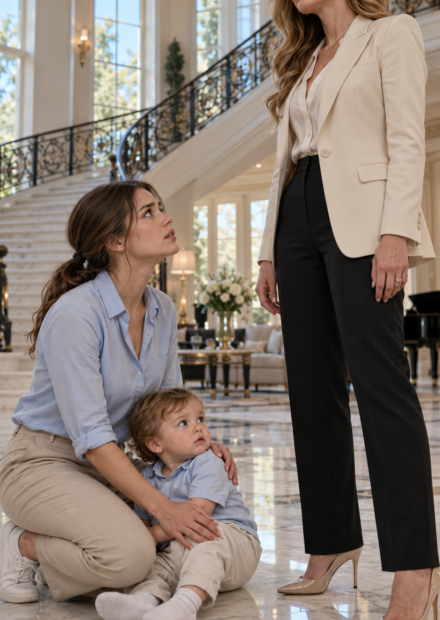
I wanted them to picture Mom on the floor.
I wanted them to hear the words.
Get up and hold my dress. You’re here to serve me.
I wanted the truth to burn through the version Victoria was building.
But Mom saw what I was becoming.
“Revenge and truth are not the same thing,” she said.
“I’m not asking for revenge.”
“You’re close.”
I leaned back.
She took my hand.
“You canceled the wedding.”
“Yes.”
“That was the decision you needed to make.”
“Yes.”
“Then make it cleanly.”
I looked at her.
“Cleanly?”
“Don’t become cruel because someone was cruel to me.”
That was my mother.
She could barely sleep on her right side because of the bruise, and she was worried about the moral quality of my breakup.
I squeezed her hand.
“I don’t know how to do this.”
“Yes, you do.”
“No.”
“Yes.”
She smiled sadly.
“You just don’t like how much it costs.”
She wasn’t talking about money.
The financial damage was bad enough.
I lost deposits.
Victoria’s parents demanded reimbursement for some expenses.
My lawyer friend told me not to agree to anything over the phone and to keep every communication in writing.
I hated that my life had reached a point where the words lawyer and wedding occupied the same sentence.
But the real cost was emotional.
People took sides.
Not because I asked them to.
Because that is what people do when a relationship explodes.
Some of my friends supported me immediately.
Others urged me to reconcile.
“You’ve been together two years,” one said. “People make mistakes.”
I kept hearing that word.
Mistake.
A mistake was ordering the wrong flowers.
A mistake was forgetting a birthday.
A mistake was losing your temper and saying something stupid, then feeling horror when you realized the damage.
Victoria had shoved Mom.
Watched her fall.
Ordered her to stand.
Then complained about lunch.
The push mattered.
But what happened after the push mattered more.
I tried explaining that to my friend.
He finally understood when I asked one question.
“If someone did that to your mother, would you marry them three weeks later?”
He didn’t answer.
That told me enough.
Claire was different.
Claire didn’t soften.
She doubled down.
Four days after the boutique, she came to my condo without warning.
Mom had gone home by then.
I almost didn’t open the door.
Then I remembered she was still my sister.
I let her in.
She walked straight to the living room.
“You look terrible.”
“Thanks.”
“I’m serious.”
“So am I.”
She sat on the edge of the couch.
For once, she wasn’t dressed like she was heading somewhere expensive with Victoria.
Jeans.
Sweater.
Hair tied back.
She looked like my sister again.
That made what happened next harder.
“Victoria hasn’t eaten,” she said.
I stared at her.
“That’s why you came?”
“She’s devastated.”
“Claire.”
“She keeps crying.”
“Claire.”
“She can’t sleep.”
“What do you want me to do?”
“Talk to her.”
“No.”
“You don’t have to get married next week.”
“Good, because I’m not.”
“You could postpone.”
“No.”
“Counseling.”
“No.”
“One conversation.”
“No.”
She stood.
“Why are you being like this?”
I laughed.
“Being like what?”
“So cold.”
“You watched Mom hit the floor.”
Her face tightened.
“There it is again.”
“There what is?”
“You keep saying it like Victoria picked her up and threw her across the room.”
I stood too.
“She put both hands on her and shoved.”
“And she apologized.”
“To me.”
“What?”
“She apologized to me. Has she apologized to Mom?”
Claire hesitated.
That answered my question.
“No.”
“Maybe Mom won’t speak to her.”
“Victoria knows her number.”
“Daniel—”
“She knows where Mom lives.”
“She’s scared you’ll twist it.”
I stared at Claire.
“Twist what?”
“Anything she says.”
“Like ‘I pushed you and I’m sorry’?”
Claire crossed her arms.
“You’ve already decided she’s a monster.”
“No. I decided I won’t marry her.”
“That’s the same thing.”
“No, it isn’t.”
I walked toward the kitchen.
My hands were shaking now.
“People can be complicated. People can have good qualities and still do things I won’t accept.”
“You loved her.”
“I did.”
That stopped her.
Because I used the past tense.
Again.
Claire’s anger flickered.
For half a second, I saw fear.
“You really mean it.”
“Yes.”
“You’re throwing away everything.”
“No. I’m choosing what comes next.”
She looked at me as though I had betrayed her personally.
Maybe, in a way, she felt I had.
Victoria had given Claire access to a world she loved.
Private clubs.
Designer events.
Expensive restaurants.
People with homes on islands.
Claire had spent much of her life trying to escape the smallness of our childhood.
I understood that better than she thought.
After Dad died, we were the kids who couldn’t go on the ski trip.
The kids whose mother drove an old Buick with rust near the wheel wells.
Claire noticed every difference.
She hated secondhand clothes.
Hated bringing friends home.
Hated that Mom checked prices before ordering at restaurants.
I reacted the opposite way.
I became protective of home.
Claire became determined to outrun it.
Victoria represented everything Claire had wanted when we were teenagers.
Beauty.
Money.
Confidence.
Access.
Standing beside Victoria made Claire feel like she had arrived somewhere.
And I had just blown up the bridge.
“You didn’t laugh because you were uncomfortable,” I said.
Claire’s face changed.
“What?”
“At the boutique.”
“Don’t.”
“You laughed because for one second, you saw Mom the way Victoria sees her.”
“That is not true.”
“You saw her as embarrassing.”
“Stop.”
“As someone who didn’t belong there.”
“Shut up.”
“And you hated that she reminded everyone where we came from.”
Claire slapped me.
The sound cracked through the room.
We both froze.
My cheek burned.
Her hand hung in the air.
She looked shocked.
So was I.
Slowly, she lowered it.
“Get out,” I said.
“Daniel—”
“Get out.”
“I didn’t mean—”
“Now.”
Her eyes filled.
For a second, I thought she might apologize.
Instead she grabbed her bag.
“At least Victoria knows what she wants,” she said.
Then she left.
I locked the door behind her.
I stood there for a long time.
Then I called Mom.
Not because I wanted her to fix it.
Because suddenly I understood how alone she must have felt in that boutique.
Two children.
One laughed.
One froze.
Neither protected her immediately.
She answered on the third ring.
“Hello?”
“Hey.”
“You sound strange.”
“Claire was here.”
A pause.
“What happened?”
“We argued.”
“About me?”
“About everything.”
“Daniel.”
“She slapped me.”
Silence.
Then Mom sighed.
“You two haven’t hit each other since you were twelve.”
“She hit me.”
“You deserved it when you were twelve.”
Despite everything, I laughed.
That was Mom’s gift.
She could find a window in a sealed room.
“She’s angry,” Mom said.
“She’s cruel.”
“Don’t decide who your sister is on the worst day of her life.”
“She laughed at you.”
“I know.”
“She defended Victoria.”
“I know.”
“She slapped me.”
“I heard that part.”
“How are you not furious?”
“Who says I’m not?”
I went quiet.
Mom continued.
“I’m furious. I’m hurt. And when I remember Claire laughing, I feel something I don’t know how to name.”
Her voice wavered for the first time.
My chest tightened.
“But she is still my daughter.”
“So what am I supposed to do?”
“Nothing tonight.”
“What does that mean?”
“It means some things don’t have to be solved immediately.”
I sat down.
That advice became important over the next week.
Because Victoria was trying to solve everything immediately.
She sent letters.
Flowers.
Messages through mutual friends.
A box containing photographs from our engagement.
A handwritten note appeared beneath my door.
I know what happened was wrong.
I was stressed.
I felt judged.
Your mother has never respected my boundaries.
I reacted badly.
Please don’t erase two years because of ten seconds.
I read that sentence many times.
Two years because of ten seconds.
For one night, it almost worked.
That scared me.
Because she was right about one thing.
Human beings are more than their worst ten seconds.
If I wanted perfection, I would end up alone.
I had lost my temper before.
Said things I regretted.
Been selfish.
Been defensive.
Maybe Mom was right about not defining people by their worst moment.
I sat on my bed at one in the morning reading Victoria’s letter.
I remembered our first date.
She had laughed when rain ruined her hair.
We ran six blocks through a storm and ate tacos in wet clothes.
I remembered the weekend she took care of me when I had the flu.
The surprise birthday dinner she planned.
The way she squeezed my hand during turbulence because she knew I hated flying.
People are complicated.
Love is complicated.
For the first time since the boutique, doubt entered.
Then I reached the bottom of the letter.
I hope, when you calm down, you can help your mother understand the part she played in creating this situation.
I read it twice.
Then a third time.
There it was.
Again.
Even in her longest apology, Mom still carried part of the blame.
I folded the letter.
The doubt disappeared.
The next morning, I drove to Mom’s house.
She was in the kitchen watering a plant that had been dying since 2018 but apparently lacked the courage to finish the job.
“I need to ask you something.”
“That sounds ominous.”
“Did you do anything to provoke Victoria?”
Mom slowly put down the watering can.
“No.”
“I need the truth.”
Her face tightened.
“I stepped toward her because she asked what I thought of the embroidery.”
“She asked?”
“Yes.”
“And then?”
“I said the pearls were beautiful.”
“That’s it?”
Mom hesitated.
My stomach tightened.
“What?”
“I told her your grandmother would have loved them.”
“My grandmother?”
“She embroidered my wedding veil.”
I knew that.
“Then Victoria said?”
“She said this dress was couture and not comparable to homemade things.”
My jaw tightened.
“I told her I didn’t mean they were the same. I only meant the pearls reminded me of my veil.”
“And then?”
“I moved closer because she turned slightly and I thought she wanted me to look at the back.”
Mom looked down.
“My shoe touched the edge of the train.”
There it was.
The catastrophic offense.
A seventy-four-year-old woman’s orthopedic shoe touched the edge of a wedding dress.
“I apologized immediately,” Mom said.
“Victoria turned around. She said, ‘I told you to be careful.’ I said I was sorry.”
“And then she pushed you.”
Mom nodded.
That was all.
No screaming.
No sabotage.
No dramatic confrontation.
A shoe touched a dress.
Victoria used both hands.
My decision became simpler again.
“Why did you ask?”
“She wrote to me.”
Mom’s eyes softened.
“Oh.”
“She still thinks you’re partly responsible.”
Mom looked toward the window.
Then she said, “Daniel, I don’t want you to hate her.”
“I don’t.”
“Good.”
“I just don’t want to marry her.”
Mom smiled faintly.
“That sounds healthier.”
I stayed for lunch.
Before I left, she called me back from the front door.
“Your father used to say something.”
I turned.
“What?”
“He said character is what remains when getting what you want becomes difficult.”
I smiled.
“That sounds like Dad.”
“No, it sounds much smarter than your father usually was. I think he stole it from someone.”
I laughed.
Mom did too.
Then her face became serious.
“Victoria didn’t scare me when she pushed me.”
I stopped.
“What scared me was what happened afterward.”
I knew exactly what she meant.
“She wasn’t sorry,” I said.
“No.”
“And Claire laughed.”
“Yes.”
“And Evelyn did nothing.”
Mom nodded.
“That room told the truth.”
The room told the truth.
I thought about those words the entire drive home.
Because that was the part everyone else kept missing.
They focused on ten seconds.
The shove.
But the room afterward lasted much longer.
My mother on the floor.
Victoria angry about lunch.
Claire laughing.
Evelyn drinking champagne.
Me frozen.
That room had stripped away every social rule that usually helped people hide who they were.
Nobody had time to perform.
Nobody had time to compose the right expression.
We had all reacted from instinct.
And I finally understood something that hurt almost as much as losing Victoria.
I had failed that test too.
I had frozen.
Only for a heartbeat.
But I had.
So I made myself a promise.
The next time the people I loved needed me to choose, I would not stand still.
I didn’t know then how soon I would have to prove it.