THE PHONE CALL I SWORE I WOULD NEVER MAKE
Chapter 3 – WHAT I ASKED MY FATHER NOT TO DO
I could have ruined Dominic.
That is not self-dramatization.
It is simply true.
I knew enough about my father’s world to understand what was being offered.
Augustus would never punch Dominic in the middle of the Marlowe Club.
That kind of violence was loud and unsophisticated.
Real power happened over breakfast.
A lender suddenly reconsidered a line of credit.
A board member lost confidence.
A city approval stalled.
A partner decided a project carried too much risk.
A newspaper received a phone call from someone concerned about a powerful businessman striking a female employee.
By the time anyone recognized the pattern, there would be no single act to blame.
That was how men like my father survived.
They rarely broke doors.
They convinced everyone else to stop opening them.
“Tell me what you want,” he repeated.
Dominic watched me.
So did everyone else.
I thought about my cheek.
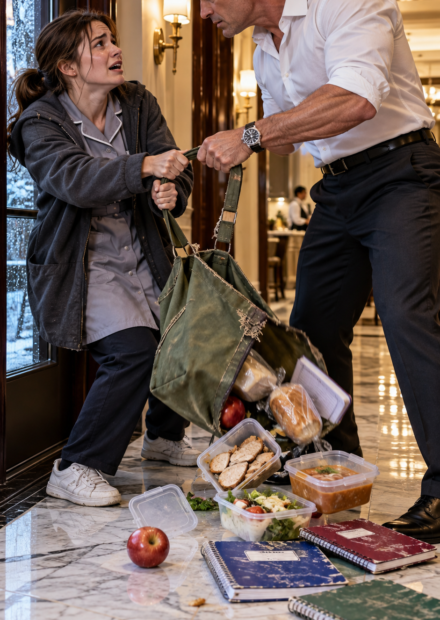
My purse emptied across a table.
Peter asking permission to search my locker again.
The guests looking away.
Dominic’s hand.
I wanted him to feel what I had felt.
Powerless.
Exposed.
Afraid.
The desire was so immediate that I almost mistook it for justice.
Then I looked at my father.
Seven years earlier, I had left because I could not bear living in a world where hurt automatically demanded more hurt.
If I used Augustus now to crush Dominic simply because I could, then what exactly had I spent seven years proving?
“I want the truth recorded.”
My father’s face remained unreadable.
Dominic blinked.
I continued.
“I want the security footage preserved.”
Peter nodded quickly.
“It will be.”
“I want a copy.”
“You’ll have it.”
“I want the incident report to say exactly what happened.”
Dominic started to speak.
I looked at him.
He stopped.
“And I want every employee in this building to know I was innocent before they leave tonight.”
My father watched me.
“That’s all?”
“No.”
Dominic’s shoulders stiffened.
I turned toward him.
“I want you to stop searching employees because somebody richer than they are points a finger.”
His face tightened.
“I don’t personally run club security policy.”
“You did tonight.”
He had no answer.
“If someone is accused of stealing, there should be evidence. There should be procedure. There should be witnesses. And nobody should be humiliated because the person complaining writes bigger checks.”
Peter looked down.
I glanced at him.
“You knew the search was wrong.”
His face reddened.
“Yes.”
“Why did you allow it?”
He looked at Dominic.
That was answer enough.
I turned back to Dominic.
“This is what you built.”
His brow furrowed.
“A room where people are more afraid of upsetting you than of doing the right thing.”
He looked around.
For the first time that night, I think he actually saw the faces.
Peter.
The bartender.
The servers.
The guests who had remained silent.
Dominic had probably believed their obedience meant respect.
I knew better.
Fear imitated respect very well from a distance.
“You want me to change club policy,” he said.
“Yes.”
“You think that fixes what I did?”
“No.”
My answer surprised him.
“Nothing fixes what you did. It only stops what you did from becoming something this place learns to accept.”
My father looked at me differently after that.
Not proudly.
That would have annoyed me.
More like he was hearing a language he once knew and had forgotten.
Dominic rubbed one hand over his mouth.
“Done.”
“I’m not finished.”
He lowered his hand.
I looked around the room.
“Everyone who watched.”
Several people shifted.
“If you recorded what happened, don’t sell it. Don’t leak it for entertainment. Give it to me if I need it as evidence.”
A younger man near the bar slowly lowered his phone.
Good.
“I’m not interested in becoming tomorrow morning’s scandal clip.”
My father spoke behind me.
“If anyone distributes footage without Charlotte’s permission—”
“Dad.”
He stopped.
I turned.
“That.”
“What?”
“That is exactly what I’m talking about.”
His expression sharpened.
“I was protecting you.”
“I didn’t ask you to threaten anyone.”
“I didn’t threaten—”
“You were about to.”
For half a second, I saw the old Augustus.
The man who could not understand why correct outcomes did not justify his methods.
Then something changed.
He exhaled.
“You’re right.”
I almost did not know what to do with that.
My father had never been good at saying those words.
Maybe seven years had changed both of us.
Dominic stared between us.
Something like understanding crossed his face.
Perhaps for the first time he realized that my leaving had not been an act of teenage rebellion.
I had left power itself.
Or at least the version of it I had grown up around.
My father looked at the phone in my hand.
“You carried that all these years?”
“Yes.”
“Why?”
I looked down.
The old black casing seemed absurdly small.
“Because leaving you and never wanting to need you were not the same thing.”
His face tightened.
I immediately wished I had said it differently.
But it was true.
He looked away.
“I called that number for six months after you disappeared.”
“I know.”
His eyes came back to mine.
“What?”
“The phone was off.”
I swallowed.
“But sometimes I turned it on just to see if there were messages.”
“There were hundreds.”
“I deleted them without listening.”
That hurt him.
I saw it.
“I’m sorry.”
“No.”
He shook his head.
“You don’t owe me an apology for surviving me.”
The words went through me like cold water.
I stared at him.
“What happened to you?”
The question escaped before I could soften it.
A faint, sad smile touched his mouth.
“You left.”
The answer was too simple.
I looked away.
Dominic’s voice entered carefully.
“Augustus.”
My father did not look at him.
“I think you should stop talking for a while.”
Under any other circumstances I might have laughed.
Dominic almost did.
Instead he nodded.
Fair enough.
Peter approached me with a clean cloth and a small bag of ice wrapped in a linen napkin.
“For your face.”
“Thank you.”
I pressed it against my cheek.
The cold hurt.
Then helped.
Peter looked ashamed.
“Claire—Charlotte—I should have stopped the search.”
“Yes.”
“I could lose my job for doing that.”
“Probably.”
His eyes widened slightly.
I was too tired to comfort him.
“I’m not asking for you to be fired,” I said. “But feeling guilty only matters if it changes what you do next time.”
Peter nodded.
“I understand.”
“I hope so.”
He walked away.
My father watched him.
“You always did sound like your mother when you were disappointed.”
That nearly broke me.
“Don’t.”
“I’m sorry.”
I turned my face away.
My mother was the wound between us.
Everything eventually returned to her.
Evelyn Carver had been the soft center of our house.
Not weak.
Never weak.
She could silence my father with one raised eyebrow.
She had believed kindness was a form of discipline.
She had remembered employees’ birthdays.
She knew the names of doormen’s children.
She gave me the silver earrings when I turned sixteen and told me, “Never wear anything so expensive that you become afraid to lose it.”
Then she died from cancer before my nineteenth birthday.
Without her, the house changed.
My father changed.
Or maybe the walls had always been dark and she had simply kept the lamps lit.
The year after her death was the worst year of my life.
My father buried himself in work.
People came to him with problems.
He solved them with force.
Not always physical force.
Usually money.
Leverage.
Pressure.
Threats spoken so politely they could be denied later.
He grew harder.
I grew more afraid.
One night, I heard shouting downstairs.
A man emerged from my father’s study with blood on his shirt.
He had smiled at me and said he had tripped.
Nobody trips hard enough to split both lips.
When I confronted my father, he told me it was none of my concern.
That was the beginning.
Three months later, I packed my suitcase.
Now he stood six feet away, older and quieter, and I did not know what to believe.
“You searched for me?” I asked.
His face changed.
“Everywhere.”
“How?”
“Private investigators.”
My stomach tightened.
“I told you not to.”
“I know.”
“Did you find me?”
He hesitated.
That answer was enough.
“When?”
“Two years after you left.”
I stared at him.
My pulse began to pound.
“You knew?”
“I knew you were in Boston at the time.”
I took a step backward.
“You knew?”
“I received a photograph.”
Anger rose so quickly I became dizzy.
“You told me you searched for seven years.”
“I did.”
“You just said you found me.”
“I found an address.”
“That is finding me!”
My father’s jaw tightened.
“I sent someone to verify it.”
My skin went cold.
“So you watched me.”
“No.”
“You had me followed.”
“For three days.”
I laughed once.
I could barely breathe.
“Three days.”
“I needed to know you were alive.”
“You had no right.”
“I know.”
“Stop saying that!”
People around us pretended not to listen.
I no longer cared.
“You don’t get to violate every boundary and then say you know it was wrong.”
He took the words without defending himself.
That made me angrier.
“What did you see?”
“Enough.”
“What does that mean?”
“I saw you leave an apartment building at six in the morning. I saw you go to work at a bakery. I saw you buy groceries. I saw you laugh with a woman outside a laundromat.”
My throat tightened.
I remembered that apartment.
Three roommates.
A radiator that only worked if kicked.
A bakery job that began before sunrise.
“I saw that you were poor,” he said.
The old shame flashed.
“And?”
“And you looked happier than you had looked in my house after your mother died.”
My anger stopped.
My father’s voice grew quieter.
“So I called the investigator home.”
I stared at him.
“You left me alone?”
“Yes.”
“Why?”
His eyes were wet.
I had never seen my father cry.
Not at my mother’s funeral.
Not when I left.
Not ever.
“Because for the first time in my life,” he said, “I understood that loving someone did not entitle me to possess their choices.”
The room blurred.
I lowered the ice pack.
He looked at my cheek again.
“I kept searching from a distance. Not to bring you home. Just to know whether you were alive.”
“That’s still not okay.”
“I know.”
This time, I let him say it.
“Why the phone?” he asked.
“What?”
“If you hated me enough to disappear, why keep the phone?”
“I never hated you.”
My voice broke.
My father closed his eyes.
That was when I saw the real wound.
Not anger.
He had spent seven years believing I hated him.
“I hated who I was becoming around you,” I whispered.
He opened his eyes.
“That’s worse.”
“No.”
“It should be.”
I looked at him for a long time.
“I was scared of you.”
My father nodded.
“I know.”
“I was scared that one day I would become you.”
Another nod.
“And tonight,” I said, “for about thirty seconds, I wanted you to destroy Dominic.”
Dominic stiffened several feet away.
I did not care.
“I wanted him to feel afraid because I felt afraid.”
My father’s expression did not change.
“And then?”
“Then I realized that was exactly why I left.”
Something passed between us.
Recognition.
Not forgiveness.
Not yet.
But recognition.
My father looked at Dominic.
“So did I.”
Dominic frowned.
Augustus spoke quietly.
“When Charlotte told me you hit her, I wanted to ruin you.”
Dominic’s mouth tightened.
“I assumed that.”
“I made three calls from the car.”
My stomach dropped.
“Dad.”
“I canceled them before I walked through the door.”
The room went still.
I stared at him.
“Why?”
My father looked at me.
“Because I remembered what I told him when he was nineteen.”
Dominic glanced away.
A man’s power is measured by what he can refuse to do.
Not by what he can get away with.
My father gave a tired smile.
“It appears I needed the lesson as much as he did.”
For the first time that night, Dominic looked directly at Augustus without fear.
There was something else there.
Grief.
History.
“Why did you help me back then?” Dominic asked.
My father’s face became distant.
“Your mother asked me to.”
Dominic froze.
“What?”
“You never knew?”
“No.”
My father looked at the platinum watch.
“After your father died, Lydia came to see me. She knew the hotel was failing. She knew you were too proud to ask anyone for help.”
Dominic stared at him.
“She said you were angry enough to mistake self-destruction for loyalty to your father.”
His throat moved.
“That sounds like her.”
“She asked me not to give you money.”
“What did she ask?”
“To teach you how not to become the kind of man who needed rescuing.”
Dominic closed his eyes.
For a moment, the wealthy, feared owner of the Marlowe Club disappeared.
I saw the nineteen-year-old boy underneath.
Father dead.
Mother frightened.
Rage mistaken for adulthood.
My father continued.
“Your mother loved that watch.”
Dominic nodded.
“It was the last thing she gave me.”
“I know.”
“She told me never to sell it.”
“I know.”
Dominic laughed bitterly.
“So when it disappeared, I lost my mind.”
My father’s face hardened slightly.
“No.”
Dominic looked at him.
“You made a choice.”
The words landed.
“Grief is not insanity. Fear is not insanity. Anger is not insanity. Those feelings may explain what rises in us. They do not choose what our hands do.”
My fingers closed around my earring.
My father looked at me.
Then back at Dominic.
“You chose.”
Dominic nodded.
“Yes.”
He turned toward me.
For the first time, I believed he was not thinking about my father.
Not my name.
Not consequences.
Me.
“I chose,” he said.
His voice was rough.
“I hit you because I was angry and because, in that moment, I believed I could.”
Nobody moved.
“That is the truth.”
I watched him.
He swallowed.
“And I am ashamed of it.”
Something in my chest loosened.
Not forgiveness.
But truth had weight.
Dominic continued.
“I cannot undo it.”
“No.”
“I can make sure nobody working for me ever has to wonder whether my anger outranks their dignity again.”
I studied him.
“Then do it.”
“I will.”
My father looked toward the doors.
“I’ll have my driver take you home.”
The old instinct rose immediately.
“No.”
He stopped.
“I can take the subway.”
“It’s after eleven.”
“I’ve taken the subway after eleven for seven years.”
His jaw tightened.
Then he caught himself.
“What would you prefer?”
The question sounded unnatural in his mouth.
That almost made me smile.
“I want a cab.”
“I can arrange—”
“I can call one myself.”
“All right.”
I slid the old phone into my hand.
My father hesitated.
“Can I ask you something?”
I almost said no.
Instead I nodded.
“May I see you tomorrow?”
The room faded.
Not come home.
Not return.
Not we need to talk.
May I see you tomorrow?
I looked at the man I had fled seven years earlier.
For the first time, he was asking.
“One hour.”
His eyes closed briefly.
“Anywhere you choose.”
“A diner.”
A faint smile appeared.
“Of course.”
“No security at the table.”
“Agreed.”
“No driver waiting outside.”
He hesitated.
I raised an eyebrow.
He exhaled.
“Agreed.”
“And don’t investigate the diner first.”
That almost made him laugh.
“I’ll try to survive the danger.”
I looked toward Dominic.
He stood beside the table holding his mother’s watch but not wearing it.
“Claire.”
I turned.
He corrected himself.
“Charlotte.”
I waited.
“I am sorry.”
This time, the words sounded different.
“I know.”
He searched my face.
“That isn’t the same as forgiveness.”
“No.”
“Do you think you ever will?”
I put my coat on.
“I don’t know you well enough to hate you forever.”
His expression shifted.
Oddly, that seemed to hurt more than anger would have.
I picked up my purse.
My father moved as though to help.
Then stopped himself.
Progress.
I walked toward the front doors.
Halfway there, I heard Dominic behind me.
“Charlotte.”
I turned.
He stood beneath the chandeliers with the watch in his palm.
“What?”
He looked down at it.
Then back at me.
“My mother used to say fear makes expensive things look priceless.”
I said nothing.
“She meant people matter more.”
He closed his fingers around the watch.
“I forgot.”
I touched the bent silver earring in my pocket.
“So did my father.”
Augustus gave a quiet sigh behind me.
I opened the door.
Cold October air struck my face.
For seven years, I had imagined returning to my father’s world.
I had assumed that if it ever happened, I would be swallowed by it.
Instead, for the first time, I walked out of a room carrying both my names.