Chapter 3 – WHAT MY FATHER COULDN’T SAY WHILE HE WAS ALIVE
My mother lived twelve minutes from me in a house my grandfather had built in 1987.
That night, the drive took twenty.
Rain had become heavy again.
Leonard sat beside me.
Neither of us spoke for the first ten minutes.
I was afraid that if I started, I would ask questions quickly enough to become cruel.
Finally, I said, “Did my father love him?”
Leonard looked out the window.
“I don’t know.”
“You knew him for thirty years.”
“I knew your father as a client and a friend. That does not mean I knew everything he felt.”
“You knew about Daniel.”
“Yes.”
“You arranged the test.”
“Yes.”
“You prepared financial options.”
“Yes.”
“You sat in that library while they discussed keeping him away from me.”
“Yes.”
Every answer tightened something in my chest.
“And you did nothing.”
Leonard turned toward me.
“That is not entirely fair.”
“I’m not particularly interested in fair at the moment.”
“I know.”
He removed his glasses and rubbed his eyes.
“Your father came to me after Daniel contacted him. At first, William believed Daniel might be attempting to establish a financial claim.”
“Of course he did.”
“He had spent his entire adult life being approached by people who wanted access to money.”
“So he assumed his own son was one of them.”
“He didn’t know Daniel was his son yet.”
“And after he knew?”
“That changed.”
“Did it?”
Leonard was silent.
I gripped the steering wheel.
“He still didn’t tell me.”
“No.”
“He still allowed Daniel to walk away.”
“Yes.”
“And my mother tried to buy his silence.”
Leonard stared forward.
“She was frightened.”
“People keep saying that as if fear absolves them.”
“It doesn’t.”
That answer surprised me.
He continued.
“Evelyn had built her life around a particular understanding of her marriage. Daniel’s existence destroyed that understanding.”
“So she decided he should disappear.”
“She wanted time.”
“Four years?”
“She wanted control.”
That sounded more accurate.
I knew my mother.
Evelyn Whitmore was not cruel in the obvious sense.
She donated to hospitals.
She remembered birthdays.
She paid college tuition for the daughter of a woman who had worked for our family for twenty years.
She could be generous.
But generosity and control had always been intertwined for her.
My mother liked helping people best when she could determine the terms.
“What exactly did she offer Daniel?”
Leonard hesitated.
“A trust.”
“How much?”
“Enough that he would never have had to worry about money.”
“And the condition?”
“A confidentiality agreement.”
I laughed without humor.
“So my half brother could be rich as long as he agreed not to be my half brother.”
“That is a harsh description.”
“Is it inaccurate?”
“No.”
There it was again.
Truth reduced to one small word.
No.
I thought of Daniel.
A man I had never met.
He had stood somewhere—perhaps in Leonard’s office, perhaps in my father’s library—and been offered enough money to change his life.
All he had to do was accept that his existence was inconvenient.
He refused.
I wondered what I would have done.
I wanted to believe I would have refused too.
But I had never been poor.
It is easy to admire integrity when nobody has offered to purchase yours at the exact moment you need rent.
Daniel had needed things.
Everyone does.
Yet he had walked away.
Then years later, his widow was asking her mother for twenty-eight dollars.
The injustice of that sat inside me like a stone.
My mother opened her front door before I rang the bell.
She wore cream trousers and a cashmere sweater.
At seventy, she remained composed enough to look prepared even when surprised.
Her gaze moved from me to Leonard.
Then she saw the envelope in my hand.
Every trace of color left her face.
“Where did you get that?”
No greeting.
No confusion.
She recognized it.
“That’s your first question?”
“Adrian—”
“Did you know Daniel Keane?”
She closed her eyes.
Only for a second.
“Yes.”
The simplicity of the answer hurt more than denial would have.
I walked past her.
She didn’t stop me.
The house smelled the way it always had.
Lemon polish.
Old books.
Fresh flowers.
My father’s portrait still hung in the central hallway.
I looked at it differently now.
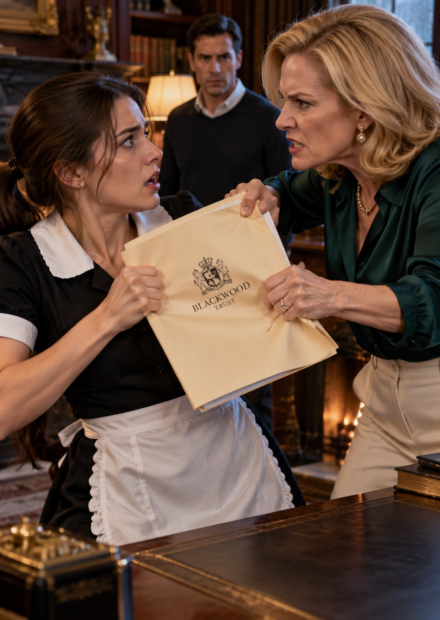
Mother led us into the library.
The same room.
The same fireplace.
The same shelves.
Four years vanished.
I could almost see my father standing where Leonard stood now.
My mother poured herself water.
Her hand trembled against the glass.
“You followed Marissa home,” Leonard said.
Mother looked sharply at me.
“You know who Marissa is?”
“Do you?”
“No.”
“Marissa Keane.”
Understanding moved slowly across her face.
Then horror.
“Daniel’s wife?”
“Widow.”
She sat down.
“I didn’t know.”
“She works for me.”
Mother stared.
“What?”
“For seven months.”
“No.”
“Yes.”
“I swear to you, Adrian, I did not know.”
I believed her.
That almost made it worse.
The family secret we had spent years protecting had quietly entered my house each morning wearing a gray coat.
My mother hadn’t engineered it.
I hadn’t recognized it.
Life had simply placed the truth inside our routines and waited to see how long we could ignore it.
“She has a son,” I said.
Mother went still.
“Daniel had a child?”
“He died before the baby was born.”
Her hand covered her mouth.
“What’s his name?”
“Owen.”
She stared at me.
I knew what she was thinking.
I thought it too.
My father had a grandson.
Her husband had a grandson.
I had a nephew.
All while we continued discussing the Whitmore family as though we were the only people entitled to the word.
Mother looked down.
“How old?”
“Ten months.”
“And Marissa?”
“What about her?”
“Is she all right?”
I thought of the phone call.
Twenty-eight dollars.
“She’s working.”
“That isn’t what I asked.”
“No,” I said. “She isn’t all right.”
Mother absorbed that.
I placed the letter on the table.
“Why didn’t you tell me?”
She looked at Leonard.
“No. Don’t look at him. Look at me.”
She did.
“I was afraid.”
“Of Daniel?”
“Of what it would do to you.”
“I was thirty-four.”
“You were preparing to take over the company.”
“What does that have to do with whether I had a brother?”
“Everything felt unstable then. Your father had health problems he wasn’t discussing. The board was nervous. Your grandfather’s estate was still creating disputes. Then Daniel appeared.”
“Appeared.”
“I don’t mean it that way.”
“It sounds exactly the way you mean it.”
Her jaw tightened.
“Please allow me to finish.”
I said nothing.
“Daniel contacted your father. William panicked. At first, yes, he thought Daniel wanted money. Then the test came back.”
“And you knew he was Dad’s son.”
“Yes.”
“Which meant he was my brother.”
“Yes.”
“What did Daniel ask for?”
Mother looked at the fire.
“Recognition.”
“Money?”
“No.”
“A job?”
“No.”
“Shares?”
“No.”
“A house?”
“No.”
“What?”
Her voice broke.
“He wanted William to say it.”
I stared at her.
“To him?”
“To you. To the family. He said he was tired of being treated like something that had happened instead of someone who existed.”
That sentence belonged to a man I could suddenly imagine.
Not clearly.
But enough.
“What did you say?”
Mother’s eyes filled.
“I said we needed time.”
“How much?”
“I didn’t know.”
“Did you ask Leonard to prepare the confidentiality agreement?”
“Yes.”
“Did Dad agree?”
“At first.”
“Why?”
“Because we were terrified.”
“You were terrified of one man with no money and no public platform?”
“I was terrified of losing my marriage.”
The honesty of it stopped me.
Mother pressed her hands together.
“I had known about Margaret.”
“You knew?”
“Not when it happened. Years later.”
“How?”
“Your grandfather told me after Margaret contacted William once about medical history for Daniel.”
“And you stayed?”
“Yes.”
“Did Dad know you knew?”
“Eventually.”
I walked away from the table.
I needed distance from her.
From Leonard.
From my father’s portrait.
“Why did Daniel wait so long to contact him?”
Mother shook her head.
“I don’t know.”
Leonard answered.
“His mother was dying.”
I turned.
He continued.
“She told him the entire story shortly before her death. Until then he had known only fragments.”
“And after?”
“He wanted confirmation.”
“Which he got.”
“Yes.”
“Then you offered him money to keep quiet.”
Mother’s face tightened.
“I thought I was protecting my family.”
“He was your family.”
The sentence silenced her.
I hadn’t planned it.
But once I said it, I knew it was the center of everything.
Daniel had been discussed as an external danger.
An intrusion.
A complication.
A claimant.
A risk.
Anything except what he was.
Family.
Mother began to cry.
I had seen her cry at my father’s funeral.
I had seen her cry when her sister died.
I had never seen her cry because of something she had done.
“I know that now,” she whispered.
“No. You know it because he’s dead.”
She flinched.
Leonard said my name.
I turned on him.
“Don’t.”
Mother wiped her face.
“You have every right to be angry.”
“I’m not interested in permission.”
“I’m trying to tell you the truth.”
“Four years late.”
“Yes.”
The word collapsed in the room.
I wanted to shout.
Instead I asked the question that had been growing since Marissa’s apartment.
“Did Dad intend to change his will?”
Leonard answered carefully.
“He discussed it.”
“Did he?”
“No.”
“Did he create a trust?”
“No.”
“Transfer shares?”
“No.”
“So he died before doing anything.”
“Yes.”
Mother spoke.
“He was going to.”
I looked at her.
“That sentence is doing a lot of work tonight.”
She lowered her eyes.
“He kept saying he needed to speak to you first.”
“But he didn’t.”
“No.”
“Why?”
Mother was silent.
Then she said, “Because I asked him not to.”
The room disappeared.
Not literally.
But there are moments when one sentence becomes the only object you can see.
I stared at her.
“You asked him not to tell me?”
“Yes.”
“Once?”
She didn’t answer.
“How many times?”
“I don’t know.”
“More than once.”
“Yes.”
“Why?”
“I thought if he waited, Daniel might decide privacy was better.”
“For whom?”
“For everyone.”
“For you.”
She looked at me.
“Yes.”
I shook my head.
“No. Don’t put me in that sentence.”
“Adrian—”
“You protected yourself.”
Her face crumpled.
“You protected the marriage you wanted people to believe you had. Dad protected his reputation. Grandfather protected the Whitmore name. Leonard protected attorney-client privilege.”
I pointed toward the door.
“And Daniel protected what little dignity all of you left him.”
No one answered.
I had never spoken to my mother that way.
I didn’t enjoy it.
That was almost the worst part.
Anger is cleaner when you hate the person who hurt you.
I loved my mother.
I had loved my father.
And suddenly I understood that loving someone does not make their failures smaller.
Sometimes it only makes them harder to carry.
Mother whispered, “Did Marissa know?”
“No.”
That surprised her.
“Daniel never told her?”
“Not your names.”
“Why?”
“I don’t know.”
Leonard spoke.
“I may.”
We both turned.
He removed a sheet of paper from his briefcase.
“I met with Daniel after William’s funeral.”
“You said that.”
“There is something else I did not tell you.”
I laughed bitterly.
“That seems to be tonight’s theme.”
Leonard accepted the insult.
“Daniel asked whether William had changed his estate documents.”
“And you told him no.”
“Yes.”
“What happened?”
“He said, ‘Good.’”
I frowned.
“Good?”
“He said he didn’t want money arriving after William’s death to pretend something had been repaired.”
I sat slowly.
Leonard continued.
“I asked whether he intended to contact you.”
“What did he say?”
“He said he had considered it.”
“And?”
“He said he was getting married.”
Marissa.
“He wanted to start his life without dragging your father’s choices into it. He said that if he ever approached you, he wanted to do it when he was certain he wasn’t doing it from anger.”
I pictured him again.
A man standing in Leonard’s office.
My brother.
Alive.
Breathing.
Choosing not to knock on my door because he wanted to make sure he came without hatred.
“He had my number,” I said.
“Yes.”
“My address.”
“Yes.”
“My office.”
“Yes.”
“He could have walked in any time.”
“Yes.”
“But he didn’t.”
“No.”
I didn’t know whether to feel abandoned or ashamed for feeling abandoned.
“How long after he got married did he die?”
“About two years.”
Two years.
We had lived perhaps fifteen miles apart.
We might have passed each other in traffic.
Stood in the same coffee shop.
Attended the same Celtics game.
I had spent thirty-eight years believing I was an only child.
For two of those years, my brother had been close enough to call.
Neither of us had known how little time remained.
I looked at my mother.
“You stole the chance for me to decide what he meant to me.”
She wept quietly.
“I know.”
“You decided the truth would hurt me, so you chose a lie that lasted until he was dead.”
“I know.”
“And now his son exists.”
At that, she looked up.
“You’re going to help them.”
It wasn’t a question.
I stiffened.
“This is not about writing a check.”
“I didn’t say it was.”
“It would be easy, wouldn’t it?”
She looked confused.
“For all of us.”
I pointed toward the portrait.
“Dad spent his entire life believing money could resolve the parts of this story that made him uncomfortable. He offered Daniel a trust. You offered confidentiality. Everyone wanted a financial instrument because nobody wanted to sit in a room and say, ‘We did this to you.’”
My mother whispered, “What do you want me to do?”
“For once, stop asking the person with more power to determine what happens next.”
She stared at me.
“Marissa decides what she wants from us.”
Mother nodded.
I stood.
“One more thing.”
“What?”
“This morning, I heard Marissa ask her mother for twenty-eight dollars to buy formula.”
Mother’s face changed.
I wanted her to understand.
Not because poverty was shameful.
Because distance had consequences.
“Your husband’s grandson needed twenty-eight dollars.”
She covered her mouth.
“And he almost didn’t have it.”
“Adrian—”
“No. Remember that.”
My voice broke.
“Every time you tell yourself silence protected the family, remember that.”
I walked toward the door.
Mother called after me.
“Adrian.”
I stopped.
She stood behind me.
There was no elegance left in her posture.
No Whitmore composure.
Only an old woman realizing that the family she had tried to preserve had already been changed by the thing she refused to name.
“I was the one who asked your father not to tell you,” she said.
“I know.”
“No.”
Her voice shook.
“You don’t understand. The night you walked into this library four years ago, William had decided he was going to tell you.”
I turned.
Mother’s tears fell freely.
“He had asked Leonard to stay because he wanted help explaining everything.”
I looked at Leonard.
He nodded once.
Mother continued.
“Then I panicked.”
I could barely hear her.
“What did you do?”
“I told him if he told you, I would leave.”
The room went silent.
My father had chosen.
Not between truth and convenience.
Between truth and his marriage.
And he had chosen silence.
Mother whispered, “He told Daniel the next day that he needed more time.”
I stared at her.
“How did Daniel respond?”
She closed her eyes.
“He said, ‘Then you haven’t changed at all.’”
I left without another word.