Chapter 5 – THE SIXTIETH DISH
The divorce took months.
Not three days.
Not one dramatic hearing.
Months.
Documents.
Negotiation.
Appraisals.
Mediation.
Signatures.
The kind of practical ending people rarely include when they tell stories about dramatic beginnings.
The condo became the largest issue.
Neither Julian nor I wanted to remain there by the end.
Too much history.
Too much money tied up in one place.
Too many rooms that had become arguments.
We agreed to sell it.
When I returned for the final walkthrough, the kitchen door stood open.
I stopped in front of it.
My body remembered before my mind did.
Cold tile.
Deadbolt.
Dark windows.
The sixty-dish menu near my feet.
I put one hand on the door.
Then stepped inside.
Empty.
The island was bare.
Cabinets open.
No champagne.
No leather menu folder.
No Julian.
No Fiona.
I walked to the place where I had sat on the floor.
For one moment, I saw myself there.
Cardigan.
Messy hair.
Phone glowing in my hand.
Darcy’s voice asking:
What do you want to do?
Leave.
That woman felt both recent and impossibly far away.
The realtor called from the hallway.
“Sloan?”
“I’m coming.”
I touched the deadbolt.
Then walked out.
The condo sold.
The financial settlement was fair.
Not cinematic.
I did not leave Julian penniless.
He did not take half my soul.
Accounts were divided according to the agreement negotiated through counsel.
Each of us kept certain separate property.
Marital property was divided.
Debts were assigned.
The financial restrictions ended when no longer necessary.
Life moved forward.
Julian rented a smaller apartment.
He found steadier consulting work.
From what I heard, he remained in therapy.
Fiona moved into a modest one-bedroom apartment near her sister.
She stopped using luxury car services.
Started shopping at a regular grocery store.
That detail came from Julian months later and made me laugh harder than it should have.
Not because ordinary groceries were punishment.
Because Fiona had once called oats peasant food.
I wondered if she bought them now.
I never asked.
I rented an apartment overlooking a quieter section of the river.
Two bedrooms.
Good light.
A kitchen half the size of the old one.
I loved it immediately.
The first night, I owned one saucepan, two plates, three glasses, and takeout Thai food.
Darcy sat on the floor with me because the dining table had not arrived.
She raised a plastic cup.
“To sixty dishes.”
I laughed.
“Never say that again.”
“To one dish, then.”
“Perfect.”
We ate noodles directly from cartons.
Best meal I had tasted in years.
Several months after the divorce was finalized, Julian sent an email.
Not a text.
Not a call.
An email.
Sloan,
I don’t expect an answer. Therapy has made me look at things I avoided. I used Mom’s expectations because they gave me a way to feel powerful when I felt insecure. Your success made me proud when we met. Later, instead of building my own stability, I started resenting yours. Mom fed that resentment because your boundaries made her uncomfortable. I let that become an excuse.
I stopped reading.
Then continued.
None of that explains away what I did. I grabbed you. I confined you. I threatened your housing even though you were carrying most of it financially. I tried to rewrite the incident the next morning because I was afraid of consequences. Those are facts.
That word.
Facts.
I read the sentence twice.
I am sorry. I hope you never again mistake being patient with someone for owing them endless access. I took advantage of that confusion.
Then:
You asked me at Darcy’s office why it mattered so much that Mom believe I could make you cook. I finally have an answer. I wanted her approval more than I wanted to be a husband worthy of yours. I’m ashamed of that.
I closed the laptop.
Walked around the apartment.
Made tea.
Returned.
The final paragraph read:
I loved you. I also harmed you. Both can be true, and the first does not excuse the second. I understand why you left.
That sentence hurt.
Because it was mature.
Because I had waited years for him to become the man who could write it.
And by the time he did, being that man no longer entitled him to be my husband.
I replied two days later.
Only three sentences.
I believe you loved me. I also believe leaving was necessary. I hope the life you build next is healthier than the one we built together.
I did not write I forgive you.
Not yet.
Forgiveness arrived slowly.
Quietly.
Without a deadline.
Mostly it meant I stopped rehearsing arguments in the shower.
Stopped imagining what I should have said to Fiona.
Stopped waking angry.
Stopped needing them to suffer enough to balance what happened.
That was when I knew revenge had never actually been what saved me.
Consequences did.
There is a difference.
Revenge asks:
How can I make you feel what I felt?
A boundary asks:
What must change so you can never do this to me again?
On Fiona’s sixty-first birthday, something unexpected happened.
She sent me flowers.
No request.
No letter.
No attempt to meet.
A small card:
No feast this year. I cooked for myself. Four dishes. It was plenty. —Fiona
I laughed.
Then I cried.
Then I put the flowers in water.
I did not call her.
That was enough.
The following week, Darcy came for dinner at my apartment.
A real dinner this time.
I cooked one roast chicken.
Potatoes.
Green beans.
A salad.
Chocolate cake from a bakery.
Darcy counted.
“Five.”
“Do not start.”
“You’re fifty-five dishes short.”
“Leave my home.”
She laughed.
Then looked at me more seriously.
“You know you’re different.”
“Better or worse?”
“Less available.”
I frowned.
“That sounds terrible.”
“It isn’t.”
She took a sip of wine.
“You used to believe being a good person meant remaining endlessly reachable.”
I considered that.
“What do I believe now?”
“You tell me.”
I looked around the apartment.
My apartment.
Nothing extravagant.
No marble island.
No thirty-first-floor views.
No guest suite occupied by someone who treated it as an entitlement.
Just quiet.
I had started painting again.
A hobby I abandoned after college.
Three canvases leaned against the wall.
My work bag sat by the desk.
No one complained that I came home late.
No one asked what I was cooking before asking how my day had been.
“I think kindness requires choice,” I said.
Darcy smiled.
“There she is.”
A year after the birthday, I attended a charity luncheon at a hotel downtown.
I almost did not go.
Fiona used to attend those kinds of events, and I did not want an accidental encounter.
Darcy told me avoiding an entire city because one woman might be in a ballroom was ridiculous.
So I went.
Halfway through the reception, I saw Julian.
Across the room.
Alone.
He saw me too.
For several seconds, neither of us moved.
Then he walked over.
Not quickly.
Not confidently.
He stopped several feet away.
“Hi.”
“Hello.”
“You look good.”
“So do you.”
He did.
Healthier.
Calmer.
There was gray near his temples I did not remember.
“How are you?”
“Good.”
“You?”
“Better.”
I nodded.
We stood in silence.
Then he said:
“Mom is here.”
My stomach tightened.
He noticed.
“She won’t approach you.”
“All right.”
“She knows.”
I nodded.
Another silence.
Then Julian smiled faintly.
“You’d hate what she served for her birthday this year.”
“I heard.”
He laughed.
“She sent you the card?”
“Yes.”
“Four dishes.”
“Apparently four was enough.”
He looked down.
“I think that birthday changed her.”
“It changed all of us.”
His eyes returned to mine.
“I’m sorry.”
This time I did not need details.
“I know.”
“Do you forgive me?”
A year earlier, I would have hated the question.
Now it felt smaller.
I thought about the kitchen.
The door.
The hair pulling.
The phone call to Darcy.
The legal documents.
The empty table.
The months after.
Then I realized something.
I no longer needed anger to keep myself away from him.
My boundary could survive forgiveness.
“Yes,” I said.
Julian’s eyes filled.
“But forgiveness does not change what happened.”
“I know.”
“And it doesn’t mean we made the wrong decision.”
“I know.”
“And it doesn’t mean—”
He smiled sadly.
“Sloan.”
I stopped.
“I know.”
For the first time, I believed him.
He did know.
That was enough.
We hugged once.
Briefly.
Then returned to different tables.
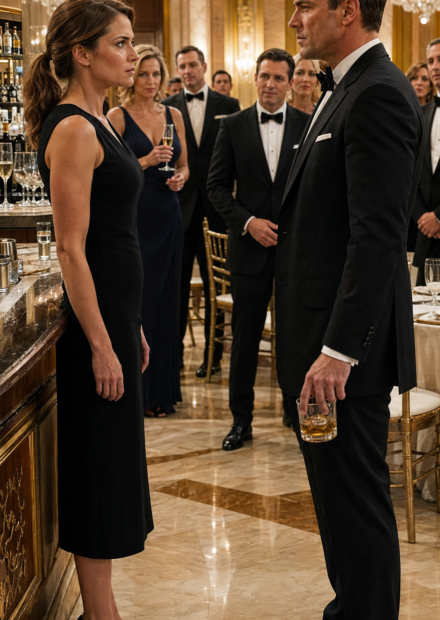
Later, I saw Fiona across the ballroom.
Gold earrings.
Black dress.
Much simpler than the gowns she once wore.
Our eyes met.
She did not approach.
She put one hand over her heart.
Then lowered it.
I nodded.
No reunion.
No dramatic reconciliation.
No need.
Some relationships heal by becoming close again.
Others heal by becoming peaceful at a distance.
Mine with Fiona belonged to the second kind.
That night, back home, I opened the old voice memo from her sixtieth birthday.
I had not listened in months.
Julian’s voice filled the room.
“Tomorrow is my mother’s sixtieth birthday. You will cook a heritage feast of sixty distinct dishes.”
Then:
“Cook it or get out.”
Then the slam.
The deadbolt.
Click.
I stopped the recording.
For a long time, I stared at the screen.
At first, that sound had represented imprisonment.
Now I heard something else.
A line being crossed so clearly that even I could no longer explain it away.
If Julian had never locked that door, how much longer would I have stayed?
Another year?
Five?
Would I still be paying Fiona’s spa bills and apologizing for working late?
Would I still call the condo his house because he shouted louder?
I would never be grateful he hurt me.
That is an important distinction.
People love saying terrible things happen for a reason.
Sometimes terrible things happen because someone makes a terrible choice.
The meaning comes later from what you choose to do next.
Julian locked a door.
I made a call.
That was the difference.
I deleted neither the recording nor the documents.
Not because I lived in fear.
Because evidence had once returned me to reality when manipulation tried to steal it.
But I moved them into an archive folder.
Not my favorites.
Not my desktop.
Archive.
Past.
Then I opened my kitchen cabinets.
I had invited six friends for dinner the following evening.
Darcy.
Nina.
Two women from work.
My neighbor Claire.
An old college professor who had recently moved back to Chicago.
I had planned to cook.
By choice.
The menu was simple.
Soup.
Salmon.
Roasted vegetables.
Bread.
Cake.
Five dishes.
I smiled.
Then I remembered Fiona’s leather folder.
Sixty lines.
Sixty demands.
Sixty proofs of devotion she thought she deserved.
I had once believed the best revenge would be giving her something more shocking than a feast.
Divorce papers.
An order.
Financial consequences.
And yes, at noon on her birthday, those documents made Fiona and Julian turn pale.
Three days after they locked me in that kitchen, they both begged me to undo what I had done.
But that was not the moment I won.
Winning happened later.
It happened the first night I slept without checking whether a door could be locked from the outside.
It happened the first time I bought something without mentally calculating whether Fiona would criticize it.
It happened when Julian cried and I did not mistake his pain for an instruction.
It happened when Fiona wrote, That is my problem, and I believed her.
It happened when I forgave them without returning.
It happened when I cooked because I wanted to, not because love had been turned into a test.
I spent five years thinking the mortgage was the biggest thing I paid for in that marriage.
It wasn’t.
The greatest cost was how often I purchased peace with pieces of myself.
My time.
My money.
My voice.
My instincts.
My no.
That was what stopped after Fiona’s birthday.
The sixtieth dish was never food.
It was the thing nobody at that table expected me to serve.
A consequence.
Not cruel.
Not illegal.
Not secret.
Simply final.
And it taught me the only lesson from that night I still carry:
If someone says they love you but only feels safe when you obey, what they are protecting is not love.
It is access.
It is control.
It is the comfort of knowing your boundaries can be pushed until they disappear.
I know my boundaries now.
They are not punishments.
They are doors I control from my side.
And nobody ever locks me in again.