Chapter 1 – THE HAND I CAUGHT
The slap never landed.
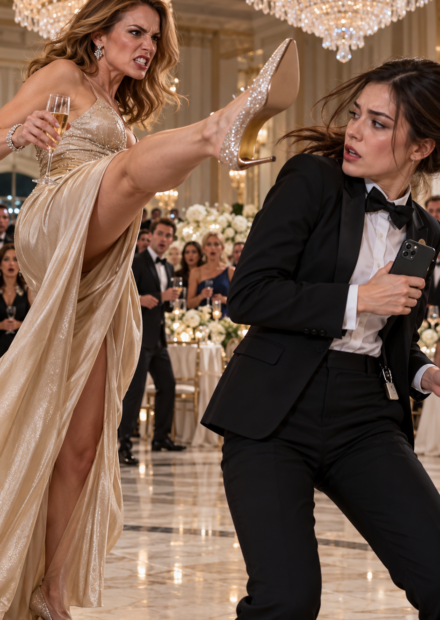
I caught Victoria Langford’s wrist three inches from the old woman’s face.
For one impossible second, nobody in the ballroom moved.
Not the senator holding a champagne flute near the stage.
Not the television executive leaning over his table to whisper something to his wife.
Not the two security guards who had been pushing through the crowd.
Not even the musicians.
The violinist’s bow stopped halfway across the strings.
The silence was so complete that I could hear the ice settling inside a crystal glass behind me.
And in the middle of it all stood me.
Emma Carter.
Twenty-four years old.
Five-foot-four on a good day.
Wearing a black catering uniform that smelled faintly of coffee, lemon polish, and the sea bass we had served during dinner.
My right hand was wrapped around the wrist of one of the richest women in Chicago.
That was the exact moment I realized I might have just destroyed my life.
Victoria Langford stared at me.
Her expression wasn’t angry at first.
Anger would have been easier.
She looked confused.
Not because I had hurt her. I hadn’t.
Not because she was afraid.
Victoria Langford did not look like a woman who had been afraid of anything for a very long time.
She looked confused because people like me were not supposed to touch people like her.
Especially not in public.
Especially not in front of three hundred guests who knew exactly how much power her last name carried.
Diamonds circled the wrist beneath my fingers.
A bracelet worth more than my father’s hospital debt glittered under the chandeliers.
“Take your hands off me.”
She didn’t raise her voice.
She didn’t have to.
Her words cut through the ballroom more sharply than a scream.
My fingers almost opened.
Almost.
Then I looked past Victoria.
The elderly woman was still sitting in the wheelchair.
Her hands trembled in her lap.
She wore a dark blue dress with a cream-colored shawl tucked around her narrow shoulders. There was nothing flashy about her. No oversized diamonds. No designer clutch sitting on the table. No entourage hovering nearby.
She looked small.
Frightened.
And terribly alone.
That was the only reason my hand stayed where it was.
“I won’t let you hit her,” I said.
My voice sounded stronger than I felt.
A gasp moved through the crowd.
Victoria blinked slowly.
“You won’t let me?”
My heart was beating so hard it hurt.
Until fifteen minutes earlier, the evening had been nothing more than another brutal shift.
The Grand Halstead ballroom had been transformed for the Moretti Foundation’s annual winter benefit. Silver candles burned along the tables. White roses spilled from crystal centerpieces. Every place setting had enough polished silverware to stock my mother’s entire kitchen.
People had arrived in cars that cost more than the apartment where my family lived.
My manager had gathered us before the doors opened.
“No mistakes tonight,” Harold Benton had warned.
He was the banquet manager, which meant he spent most events sweating through expensive jackets while pretending not to sweat.
“This is not a wedding reception. These guests own companies. They sit on boards. Some of them own the buildings your families work in. You smile. You remain invisible. You do not argue. You do not give opinions. If someone is rude, you apologize. If they are rude again, you apologize twice.”
One of the servers had laughed nervously.
Harold hadn’t.
“I mean it.”
I had meant to follow every word.
I needed that shift.
I needed the next one too.
And the one after that.
My father had been in and out of the hospital for months. Every time we thought we were catching up, another envelope arrived.
SPECIALIST.
IMAGING.
PHARMACY.
FOLLOW-UP.
BALANCE DUE.
The words had begun to look less like medical terminology and more like threats.
My younger sister, Lily, was supposed to make her next tuition payment in ten days.
She had offered to take a semester off.
My father had nearly shouted at her.
“You stay in school.”
Then he had looked at me.
That was the problem with being the oldest child in a family that had spent years surviving one emergency at a time.
Sometimes nobody had to ask.
You simply learned which burden was yours.
So I worked double shifts.
I covered call-outs.
I smiled when my feet felt like broken glass.
And that night, before Victoria Langford raised her hand, I had been determined to survive the event without attracting attention from anyone.
Then I heard a glass break.
I turned from my station and saw an elderly woman near the far edge of the dance floor.
Her wheelchair had caught against the corner of a small cocktail table.
A champagne flute had tipped over.
Some of it splashed onto the floor.
A few drops landed on Victoria Langford’s silver gown.
That was all.
A few drops.
I grabbed a cloth and hurried toward them.
“I’m so sorry,” the elderly woman was saying.
Her voice shook.
“I didn’t see the table.”
Victoria stared at the tiny wet spots on her dress.
“You didn’t see it?”
“I’m afraid the chair—”
“This gown is custom.”
“I’m sorry.”
I crouched beside the spilled drink.
“I’ll take care of it, ma’am.”
Victoria barely looked at me.
“I wasn’t speaking to you.”
I lowered my eyes.
“Of course.”
That should have been the end of it.
A spilled drink.
An apology.
A towel.
Thirty seconds.
Instead, Victoria looked down at the woman in the wheelchair.
“You shouldn’t be moving around a crowded room without someone watching you.”
Something in the elderly woman’s face changed.
“I do not need to be watched.”
“Clearly, you do.”
The old woman straightened.
She looked fragile, but there was dignity in the way she lifted her chin.
“I apologized for your dress.”
Victoria glanced around.
People were beginning to notice.
That seemed to make everything worse.
“You think an apology repairs silk?”
“No,” the woman said quietly. “But neither will humiliating me.”
I froze.
Victoria froze too.
Then she smiled.
It was a beautiful smile.
And there was nothing kind in it.
“Excuse me?”
The elderly woman’s fingers tightened on the wheelchair armrest.
“You heard me.”
I should have walked away.
That is the truth.
I should have found Harold.
I should have called security.
I should have remembered every bill on our kitchen counter and every warning my manager had given us.
Instead, I stayed.
Victoria leaned down.
“Do you know who I am?”
The old woman looked at her for a long moment.
Then she said something I would remember for years.
“Someone who thinks that question matters too much.”
A few people nearby laughed before realizing Victoria had heard them.
Her face changed.
The smile disappeared.
She reached for the handle of the wheelchair.
“Perhaps we should move you somewhere private until whoever is responsible for you comes back.”
The elderly woman pulled away.
“Do not touch my chair.”
Victoria tightened her grip.
I stood.
“Ma’am,” I said carefully, “I can help her.”
Victoria turned toward me.
“I told you to stay out of this.”
The old woman said, “Please leave me alone.”
It was the word please that did it.
Not because she sounded weak.
Because she sounded afraid.
Victoria heard it too.
And instead of backing away, she lowered her voice.
“You embarrassed me in front of half this room.”
“I spilled champagne.”
“You made me look ridiculous.”
“No,” the woman replied. “You are doing that yourself.”
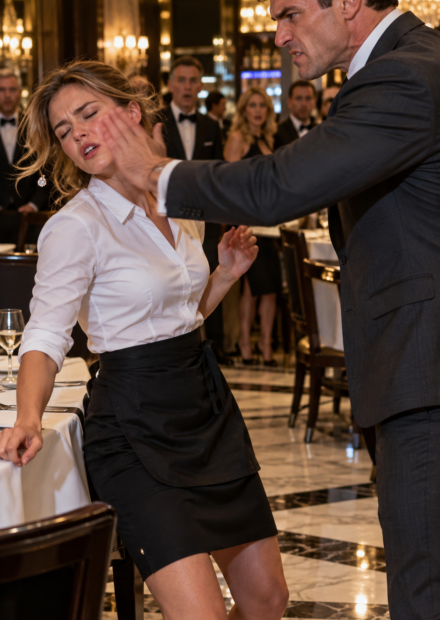
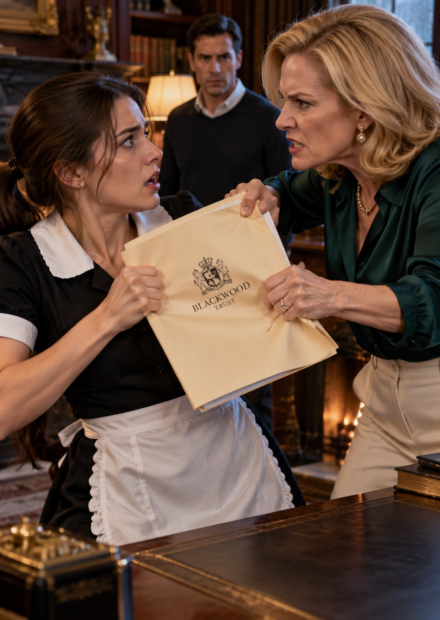
Victoria’s hand came up.
Fast.
I didn’t think.
I moved.
And that was how I ended up holding her wrist in front of three hundred of Chicago’s most powerful people.
“You have absolutely no idea who you’re touching,” Victoria whispered.
Unfortunately, I did.
Everyone who worked events in Chicago knew the Langford name.
Real estate.
Private equity.
Hospital boards.
Charity foundations.
Two newspapers.
Enough political connections that Harold once joked Victoria Langford could get a mayor to apologize for raining on her birthday.
I loosened my fingers by half an inch.
Then I felt movement behind me.
The old woman was trembling.
I closed my hand again.
Victoria’s eyes narrowed.
“You’re a waitress,” she said.
The word landed like an insult.
“You understand that, don’t you?”
My cheeks burned.
She leaned closer.
“Do you understand what happens to people like you when they forget their place?”
Around us, no one spoke.
That hurt almost as much as the threat.
The room was full of people who could have stopped her.
People with money.
Power.
Security details.
Companies.
Titles.
They watched.
A man near the stage stared at his drink.
A woman at the next table pressed her lips together.
Someone lifted a phone and then seemed to think better of it.
Nobody moved.
That was when the real fear reached me.
Not fear of Victoria’s hand.
Fear of Monday morning.
Fear of Harold telling me to empty my locker.
Fear of seeing my father pretending not to notice another bill.
Fear of Lily standing in our kitchen and saying she would take the semester off after all.
I imagined all of it in one brutal flash.
My fingers began to shake.
Victoria noticed.
Her smile returned.
“There,” she whispered. “Now you’re beginning to understand.”
I swallowed.
Then I looked at the woman in the wheelchair.
If I stepped away, Victoria would know she had won.
The entire room would know it.
Worse, the woman behind me would know it too.
So I took the deepest breath I could manage.
“If protecting her costs me my job,” I said, “then I guess it costs me my job.”
This time the gasp was louder.
Victoria’s face went completely still.
“You’ll regret this.”
A voice came from behind the crowd.
“Release Miss Carter.”
My blood turned cold.
Victoria stopped breathing.
So did I.
The crowd separated.
A tall man stepped out from between two marble pillars.
I recognized him a second later.
Vincent Moretti.
Everyone in Chicago knew the name.
Hotels.
Commercial property.
Investments.
Technology holdings.
Construction.
A dozen other businesses I had only ever read about.
He was younger than I had expected—early forties, maybe—but there was something about him that made the room rearrange itself without his asking.
People straightened.
A city councilman took a step backward.
One of the security guards moving toward me immediately stopped.
Victoria recovered first.
“Mr. Moretti.”
Vincent kept walking.
Her expression changed instantly, anger smoothing into concern.
“This waitress assaulted me.”
I released her wrist.
My hand dropped to my side.
“She completely misunderstood the situation,” Victoria continued quickly. “There was an incident, and I was attempting to handle it. She became aggressive.”
Vincent walked past her.
He didn’t look at her.
He didn’t look at me.
He went to the elderly woman.
Then one of the richest men in Chicago lowered himself onto one knee beside her wheelchair.
His face changed.
The hard control vanished.
“Mother.”
I stopped breathing.
Mother?
He touched the woman’s shoulder.
“Are you hurt?”
She shook her head.
“No.”
“What happened?”
“I’m all right, Vincent.”
His mother.
My stomach dropped so violently that I thought I might be sick.
The woman I had just defended—
the woman Victoria Langford had almost slapped—
was Isabella Moretti.
Vincent Moretti’s mother.
Around us, whispers started immediately.
Victoria took one step backward.
Then another.
Vincent checked Isabella’s hands, her face, the side of her wheelchair.
Only after he seemed convinced she was physically unharmed did he rise.
The tenderness disappeared from his expression.
He looked at Victoria.
I had never seen someone lose confidence so quickly.
“Vincent,” she began, “this has been blown completely out of proportion.”
He said nothing.
She tried again.
“Your mother’s chair struck my table. I was concerned she was becoming upset.”
Isabella looked up at her son.
“She was about to hit me.”
Victoria went pale.
“That is not what happened.”
“It is,” I said.
Every face turned toward me.
I immediately wished I could swallow the words.
But they were already there.
Victoria laughed once.
“Of course the waitress says that. She is the one who put her hands on me.”
Vincent finally looked at me.
His eyes were dark and unreadable.
I had no idea whether he believed me.
No idea whether I had just made everything worse.
His gaze moved over my uniform.
My name tag.
My shaking hands.
“What is your name?”
“Emma.”
My throat was dry.
“Emma Carter.”
For several seconds, he said nothing.
Then he nodded slowly.
“I’ll remember it.”
I didn’t know if that was a promise.
Or a warning.
Before I could decide, Harold appeared at the edge of the crowd.
His face was nearly gray.
“Emma.”
I knew that tone.
He had used it once when a server dropped an entire tray on the governor’s wife.
“Come with me.”
Victoria crossed her arms.
“There should be consequences.”
Vincent looked at her.
“There will be.”
Something in his voice made her stop smiling.
Harold led me toward the service corridor.
I glanced back once.
Vincent was standing behind his mother’s wheelchair now.
Victoria faced him.
And for the first time that evening, she looked like the person who was afraid.
The service door closed behind me.
The noise of the ballroom disappeared.
Harold turned.
“What in God’s name have you done?”
And suddenly, being brave felt very different when there were no chandeliers, no shocked guests, and no frightened old woman left to protect.
There was only me.
My manager.
My paycheck.
And the terrifying possibility that Victoria Langford’s threat had already begun.